Haier's RDHY vs. Bayer's DSO
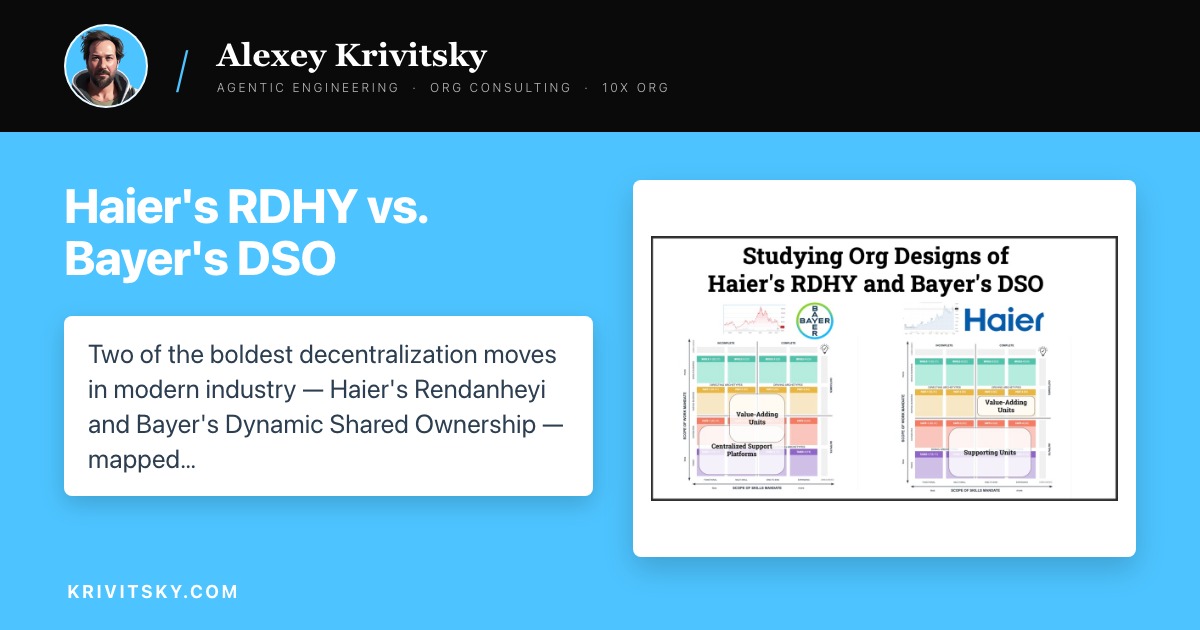
TL;DR:Haier and Bayer both dismantled hierarchies but took different paths. Haier's micro-enterprises are independent P&L centers with digital contracting; Bayer's squads are cross-functional but still lean on centralized coordination. Mapped on Org Topologies, Haier reaches higher on both axes. Both prove decentralization works — the question is how far you push autonomy.
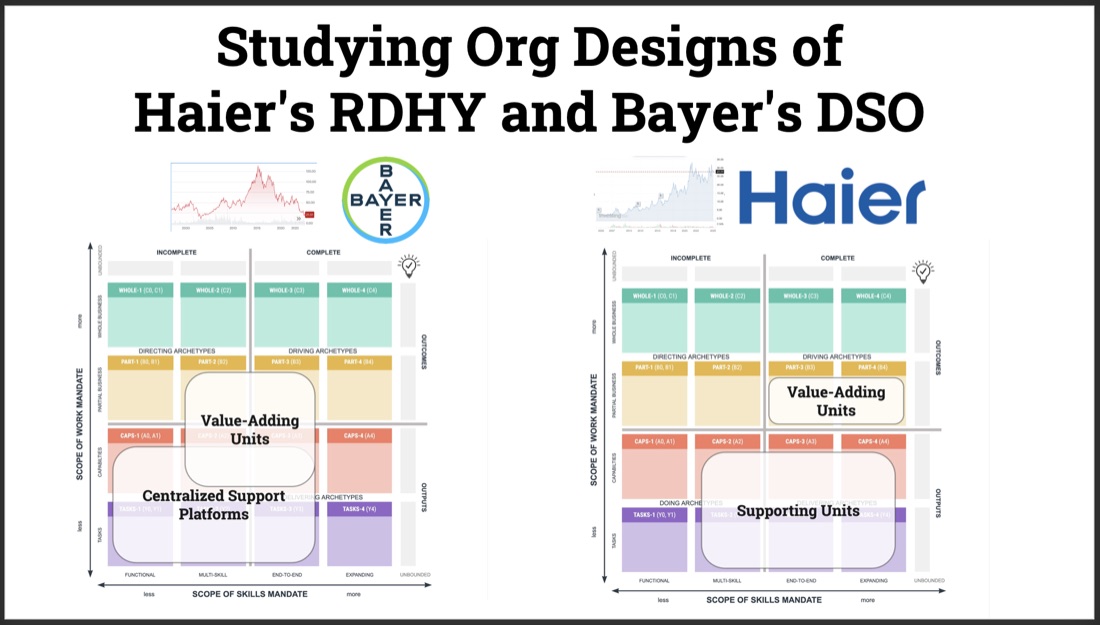
What This Article Covers
Two of the most ambitious organizational redesigns in modern industry — Haier's Rendanheyi (RDHY) and Bayer's Dynamic Shared Ownership (DSO) — share a common ambition: dismantle the traditional pyramid and push decisions to the frontline. They also differ in almost every respect that matters: origin, structure, age, cultural drivers.
This piece walks through both models, maps their work units on the Org Topologies two-axis grid, and shows what each gets right — and where each is, in different ways, still incomplete.
Sections, in order:
- Haier's transformation
- Bayer's transformation
- Similarities and differences: RDHY and DSO
- Studying org designs of RDHY
- Studying org designs of DSO
- Comparing and contrasting the two models
- Putting it all together
1. Haier's Transformation
The Haier Rendanheyi model (RDHY) is a management philosophy developed under the leadership of Haier's founder, Zhang Ruimin. It is a radical departure from traditional hierarchical structures — built on the idea that every employee's effort should align directly with customer (or user) value creation.
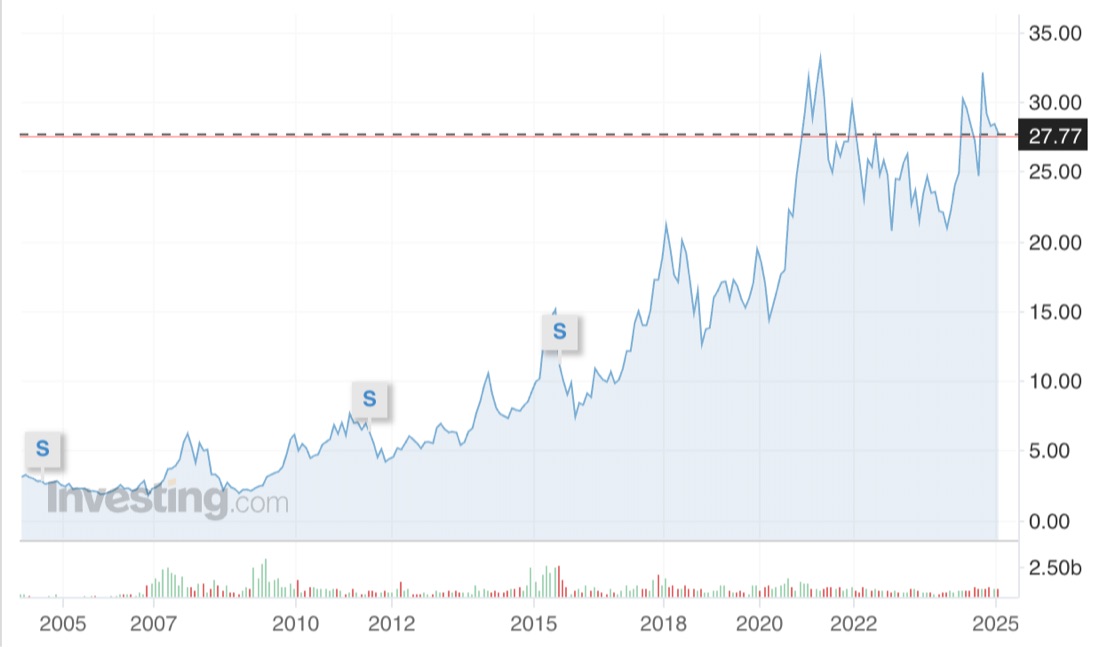
Haier's journey toward a decentralized, customer-centric organization began in earnest around 2005 — a sharp break from conventional hierarchy. Over the following years, and especially around 2012, Haier refined the approach by breaking its operations into thousands of micro-enterprises that interact directly with users, institutionalizing entrepreneurial autonomy and customer-focused value creation.
Reported outcomes include: hierarchical layers reduced from 12 to 3 across subsidiaries, a 67% faster decision-making cycle compared to 2021 benchmarks, and a target — by 2025 — to derive 60% of revenue from ecosystem services through AI integration and cross-industry partnerships.
2. Bayer's Transformation
Bayer's Dynamic Shared Ownership (DSO) is a sweeping transformation of a traditional hierarchical structure into a more agile, decentralized system — one that shifts decision-making and ownership closer to the frontline. Much like Haier's RDHY, DSO is designed to empower employees and create a more responsive, customer-centric organization. But it emerges from a very different corporate context and set of challenges.
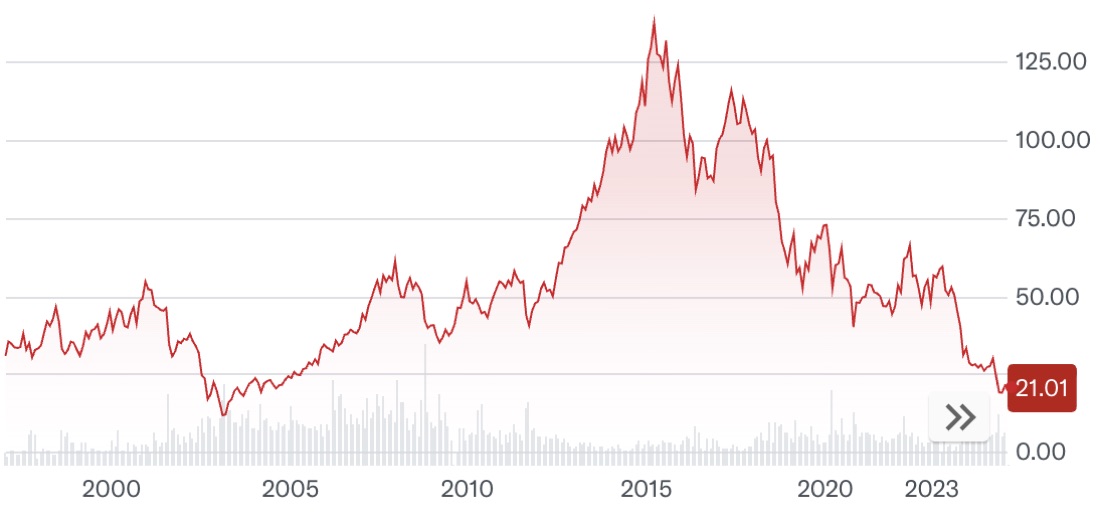
Bayer began restructuring its traditional pyramid-shaped organization into small, empowered squads around 2018–2019. The initiative accelerated significantly around 2020 in response to performance challenges and the need for faster, market-responsive decision-making. The creation of agile, cross-functional squads is a more recent development of the model. The goal: shift power to frontline teams while maintaining interdependent coordination through digital platforms and agile processes.
It is still early to judge the success of the DSO implementation — Bayer is only a few years into the change (compared to Haier, who started almost two decades ago). As of February 2025, Bayer's CEO Bill Anderson, who was appointed in 2023, continues to lead Bayer through a major restructuring program aimed at reducing hierarchy and cutting costs by €2 billion by 2026. Bayer's recovery toward a shinier future is likely still ahead.
3. Similarities and Differences: RDHY and DSO
Both models share similar ambitions — decentralize decision-making, empower frontline employees, focus on customer value. The contexts and drivers, however, differ:
- Origin. Haier's model was born out of the need to transform a manufacturing company in a rapidly evolving Chinese market. Bayer's DSO is a response to internal performance challenges and the demands of a global pharmaceutical and life sciences conglomerate.
- Structure. Haier's approach breaks the organization into thousands of micro-enterprises and ecosystem micro-communities. Bayer is reconfiguring its structure into autonomous, cross-functional squads within a "flat army."
- Cultural drivers. Both require a significant cultural shift. Haier's journey is about aligning every employee's value with customer value. Bayer's DSO is similarly designed to transform mindsets from hierarchical control to shared, mission-driven ownership.
In summary:
- Haier. Most employees are reorganized into micro-enterprises (and aggregated into ecosystem micro-communities), but some functions — especially centralized support — remain outside the direct micro-enterprise structure.
- Bayer. A significant portion of the workforce is restructured into agile, cross-functional squads, yet certain central functions and corporate support roles are not organized this way.
4. Studying Org Designs of RDHY
Core Principles of RDHY
1. Human-centric value creation. At its heart, the model is built on the idea that "Ren" (人, meaning "people" or "employees") and "Dan" (单, "orders" or customer demands) should be "HeYi" (合一, "integrated"). In other words, the personal value of every employee is directly tied to the value they create for users. This "win-win" concept drives a culture where every individual is seen as an entrepreneur, with incentives and rewards linked to how well they serve customer needs.
2. Decentralization and self-organization. Traditional middle management and rigid bureaucracies are replaced with a network of micro-enterprises (MEs) — autonomous units. Each small unit (often around 10 people) operates almost like an independent startup within the larger organization. This decentralization enables rapid decision-making and agile responses to customer feedback — what Haier calls "zero distance" between the employee and the end-user.
3. Entrepreneurial autonomy. Rather than a top-down, command-and-control system, the Rendanheyi model delegates authority to the lowest levels. Employees are given decision-making power and a share in the success of their projects. The entrepreneurial spirit is encouraged through systems that reward innovation and accountability, making every micro-enterprise responsible for its own profit and loss.
Work Units of RDHY
Haier's RDHY isn't limited to autonomous micro-enterprises (MEs). Over time, the model has evolved to include several complementary unit types:
- Micro-enterprises (MEs). Small, autonomous business units — typically 10 to 15 employees — that operate as independent profit-and-loss centers within the larger corporate structure. They are empowered to make critical decisions, hire and manage talent, and directly engage with customers to identify and meet their needs, fostering an entrepreneurial culture where every employee acts as a mini-entrepreneur. MEs are the foundational building blocks of Haier's decentralized organization, and they often collaborate and interconnect through ecosystem micro-communities (EMCs) to share resources and co-create value.
- Ecosystem Micro-Communities (EMCs). MEs are not isolated; they are designed to interconnect. Groups of MEs come together to form EMCs — clusters or communities that collaborate to address more complex user scenarios. In practice, EMCs are often divided into subtypes (for example, "solution EMCs" and "experience EMCs"), with one set focusing on developing solutions (R&D or manufacturing) and the other on user engagement and experience. The grouping helps the organization tackle larger market challenges while still maintaining the agility of small entrepreneurial units.
- Supporting shared services and platforms. In addition to MEs and EMCs, Haier has built internal service platforms that function as support units. These manage essential services — HR, procurement, logistics — reducing the need for traditional middle management and allowing the MEs to focus on value creation and customer engagement. Platforms like COSMOPlat serve as internal marketplaces where units can interact, bid for services, or share resources in a transparent, market-based manner.
Together, these three layers create a dynamic ecosystem in which individual entrepreneurial units drive rapid innovation and customer-centricity, while centralized platforms and inter-unit communities ensure coordination and resource sharing across the whole enterprise.
Disclaimer
Below are publicly available real-life examples. These are probably some of Haier's most advanced and successful cases — that's why they have been promoted. They are great for illustrating the power of the model.
When we later map these teams with Org Topologies, it is worth remembering that those assessments are likely the outliers — in the positive direction. We predict that not all teams at Haier are this advanced and would probably be assessed lower on the map. The same applies to Bayer's example teams further below.
Our intention is not to create a statistically correct assessment — we simply lack the data for such a study. Our goal is to show the qualitative (not quantitative) potential of these two very different models. Our mission is to inspire other organizations to get the change going. (For another case study using Org Topologies mapping, see LeSS Adoption at Poster POS.)
Real-Life Examples of MEs
Mask Supply Microenterprise. During the COVID-19 pandemic, a small group of Haier employees recognized a critical shortage of protective masks. They quickly formed an ME to source raw materials, organize production, and distribute masks at scale. While it emerged to solve a specific crisis, it evolved to manage the entire supply chain for the product line, leveraging external suppliers and digital tools for smart contracting.
Smart Home Appliance Microenterprise. One of Haier's flagship MEs focuses on the development of integrated smart home solutions. This unit designs, produces, and continuously refines products like refrigerators, washing machines, and air conditioners by directly engaging with customers. Its work spans the entire value chain — from R&D and manufacturing to marketing and service — and it often collaborates with other MEs within an EMC to address complex user scenarios.
GE Appliances Microenterprise (global adaptation example). Following Haier's acquisition of GE Appliances, parts of the U.S. business were reorganized into autonomous micro-enterprises. Each ME targets a distinct product line (for example, air conditioners or washing machines) and is empowered to handle everything from product innovation to market launch, tailoring solutions to local customer needs. The structure has allowed the unit to operate with startup-like agility while contributing to overall brand performance.
Mapping Haier's Org Design with Org Topologies
The Org Topologies map offers a visual aid to make sense of org design, beyond frameworks and ambiguous terminology.
The horizontal axis represents the Scope of Skills Mandate: the levels of skill composition that work units are allowed to apply doing certain work — from Functional, to End-to-End, and even Expanding beyond that.
The vertical axis represents the Scope of Work Mandate: the levels of work that units are expected to perform — from the lowest Task level, to Partial, and even Whole Business.
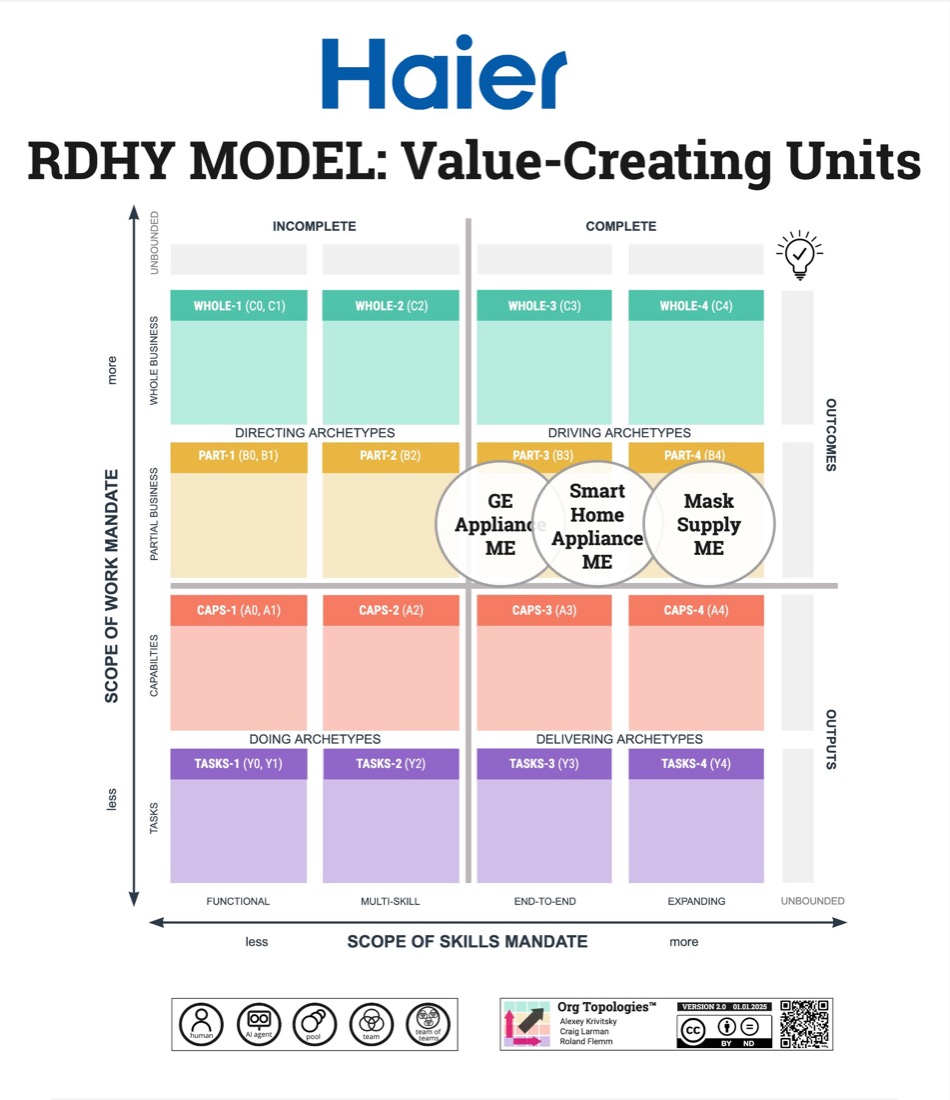
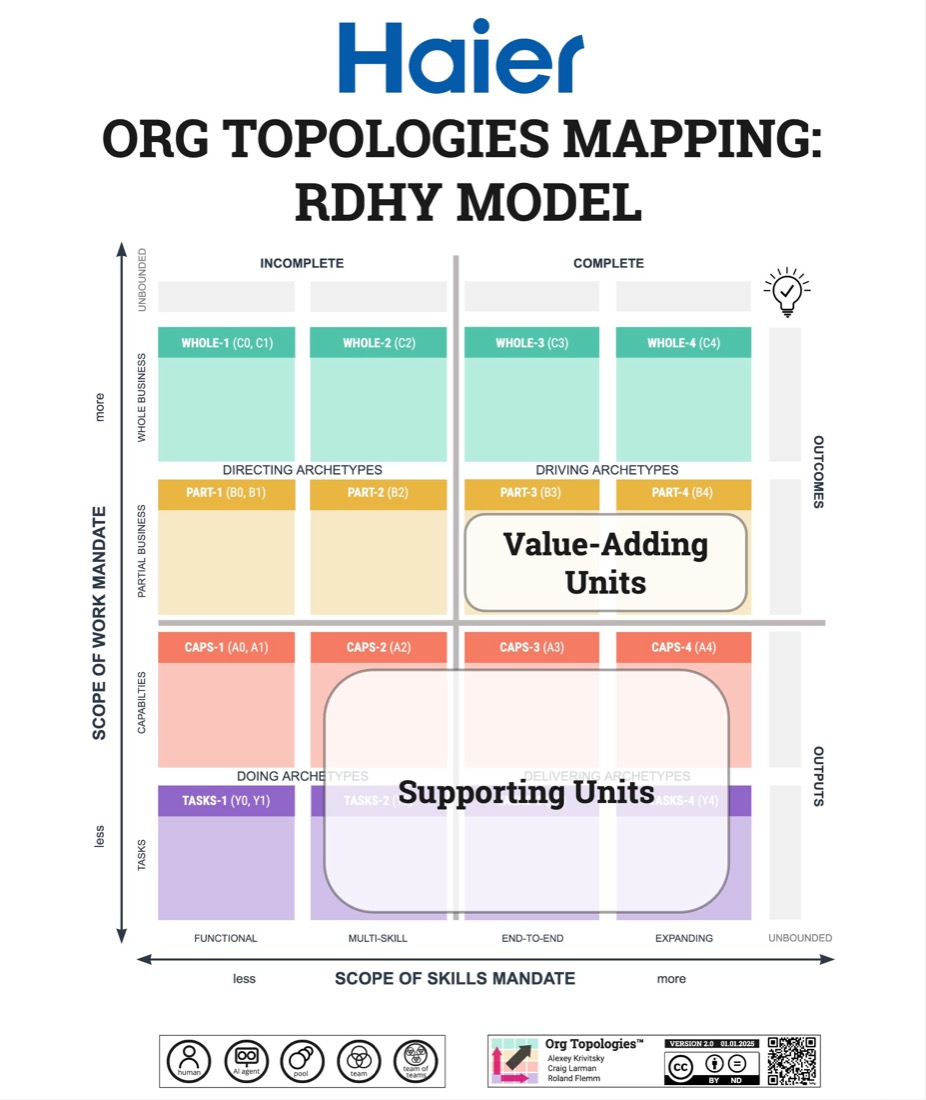
Below are the assessments of the sample value-creating units of Haier's RDHY model.
Mask Supply Microenterprise
- Horizontal: Expanding — although this unit initially formed with a functional/multi-skill base to address a crisis, it rapidly integrated external partners and digital contracting, continuously acquiring new capabilities.
- Vertical: The unit is responsible for a specific product line (protective masks) and manages a substantial portion of the supply chain without covering a fully diversified business — Partial-Business Focus.
Smart Home Appliance Microenterprise
- Horizontal: This flagship unit covers the entire value chain (from R&D and manufacturing to marketing and service), operating independently to deliver complete End-to-End smart home solutions.
- Vertical: It functions as an independent profit-and-loss center with Partial-Business Focus, managing a complete business segment that delivers end-to-end value to customers within Haier's broader product landscape.
GE Appliances Microenterprise
- Horizontal: Following Haier's acquisition, this unit was reorganized to handle an entire product line with full End-to-End autonomy, mirroring a startup-like approach.
- Vertical: Structured as a standalone profit center responsible for delivering a complete business solution in its segment — Partial-Business. Each unit is dedicated to a distinct product line (for example, air conditioners or washing machines) and is empowered to manage everything from product innovation to market launch.
The visual representation of the assessment:
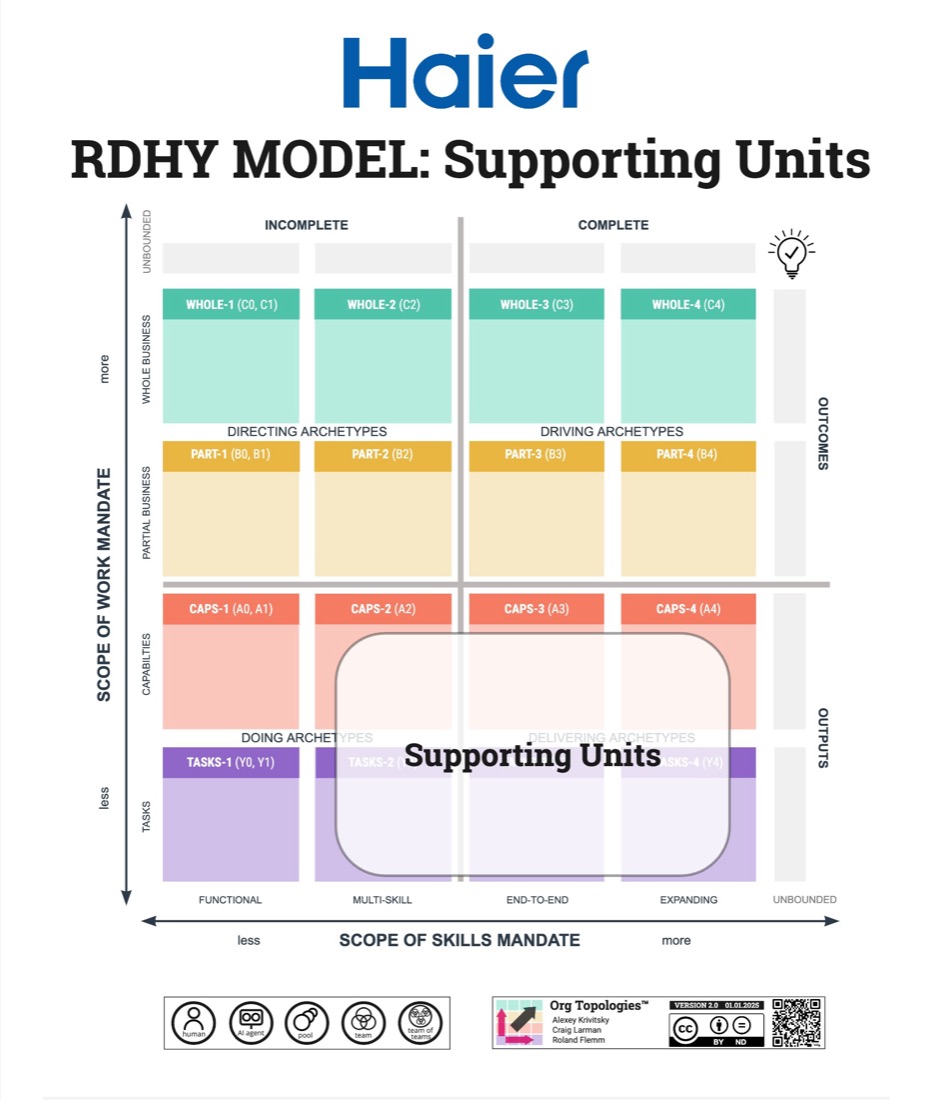
Now let's assess the supporting shared services and platforms.
- Horizontal: Typically mapped between the Multi-Skill and Expanding levels — they are capable of building internal service platforms. We don't have the exact details of their composition or dependencies on other units, so we assume they are mostly complete units.
- Vertical: Positioned in the Task Focus to Capabilities Focus range. Their responsibility is narrowly defined — manage critical support tasks and provide operational capabilities. They do not handle complete business outcomes; they ensure that processes and resources are in place for the MEs and EMCs to function efficiently.
On the map:
We did not assess Ecosystem Micro-Communities (as clusters of MEs) because our focus is on fine-grained work units. Evaluating larger groups, such as ecosystems or business divisions, does not accurately reflect workers' mandates and usually creates a misleading picture.
5. Studying Org Designs of DSO
Core Principles of DSO
1. Mission-driven value creation. Bayer is shifting the focus from traditional quarterly KPIs to outcomes aligned with its long-term mission — "Health for all, Hunger for none." Decisions and rewards are now tied directly to how well teams create real, tangible value for customers.
2. Network of autonomous, cross-functional teams. Instead of a rigid, top-down hierarchy, Bayer is restructuring into a "flat army" of multidisciplinary, self-governing teams (often called "squads"). These teams are empowered to make decisions independently, drawing on diverse skills that span functions such as R&D, marketing, and supply chain management. The decentralized model encourages faster, more informed decisions at the point of customer contact.
3. Shared ownership and empowerment. DSO replaces conventional management control with shared ownership. Frontline employees — from field sales reps to technical advisors — are given real decision-making authority and held accountable for outcomes. Their performance and compensation become directly linked to the value they deliver to customers, fostering a strong entrepreneurial spirit across the organization.
Work Units of DSO
Bayer's DSO reconfigures the organization into several types of work units that work both autonomously and collaboratively. Although detailed internal information is not fully disclosed publicly, industry reports and management insights suggest the new structure includes the following key units:
- Agile squads. Small, cross-functional teams (typically 5–15 members) composed of employees from various disciplines — R&D, marketing, sales, supply chain — who are empowered to make quick, autonomous decisions. Squads execute on specific projects or market opportunities and are oriented toward rapid innovation and customer responsiveness.
- Cross-functional cells. In certain strategic areas, Bayer has set up specialized cells that bring together experts from multiple functions to tackle complex, integrated challenges. These cells often work on end-to-end value creation projects, such as new product development or digital transformation initiatives, ensuring every aspect from conception to market delivery is coordinated.
- Centralized support platforms. Although the aim is decentralization, Bayer maintains certain central service units that provide standardized functions and services (IT, HR, procurement, finance) underpinning the agile squads. These platforms support the squads by delivering standardized tools, resources, and process frameworks that enable faster decision-making and smoother inter-team collaboration. Rather than engaging directly in market-facing innovation, they streamline operations, reduce overhead, and enable faster decisions by automating routine tasks and ensuring consistent processes across the organization.
- Integration and coordination forums. These forums — regular "scrum-of-scrums" meetings, digital collaboration platforms, designated liaison roles — exist to synchronize the work of Bayer's agile squads. They facilitate the sharing of progress, resolution of inter-squad dependencies, and alignment of outputs with overall corporate strategy. They are the glue connecting autonomous teams while ensuring collective efforts drive toward shared business outcomes.
Each of these work units contributes to the overall DSO approach by combining decentralized autonomy with the mechanisms for coordination and shared value creation. This blend of independence and interdependence is central to Bayer's effort to transform into a more responsive and innovative organization in today's fast-paced market environment.
Disclaimer
There is much less information publicly available on DSO compared to RDHY. For one, DSO is much younger. Secondly, its power is yet to be seen. Lastly, all the information we are basing our assessment on has been pushed out by Bayer's marketing itself, which is likely the best-case scenario plus some early, hard wins.
So, we hardly know anything about the model's downsides or how broadly the model has been adopted in the enterprise.
Yet, even without quantitative accuracy, we believe our analysis can be useful to see the potential of the DSO model — not its particular implementation at Bayer, which is yet to be studied thoroughly in the years to come.
In any case, DSO is by far the boldest change model that we know of in the pharma and chemical industry. If it proves successful, we will see it spread across the industry. Then we will get more data and insights to perform a more thorough study.
Real-Life Examples of Squads
Bayer Crop Science Squad (Southern Iowa). Led by Barry Jacobson in Bayer Crop Science, this squad is composed of field sales representatives, technical agronomists, and customer business advisors. The team rapidly develops proposals based on direct interactions with farmers and local ag retailers. They identify specific challenges in the field, collaboratively design solutions, and implement them without the delays of traditional approval hierarchies. Their work has led to faster decision-making and improved responsiveness to market needs, directly aligning with Bayer's push for frontline empowerment.
Bayer Italian Innovation Squad (healthcare/pharma). In Bayer's European operations, an agile squad was formed to address a pressing healthcare challenge. The team — drawing talent from R&D, design, and operations — collaborated to develop a tool designed to make injections easier for hemophiliac patients. By rapidly iterating their solution over a period of just 2–3 months, the squad demonstrated high responsiveness and creativity. Their cross-functional collaboration allowed them to innovate swiftly while directly addressing user pain points — a critical aspect of Bayer's transformation.
Bayer Global Design Teams. Bayer has instituted around 70 design teams globally, which operate as agile work units responsible for redesigning key corporate processes — from supply chain management to digital transformation initiatives. These teams work cross-functionally to reengineer and optimize processes across the organization. Their efforts are critical for aligning disparate parts of the business under the new DSO model, ensuring that innovation and efficiency improvements are integrated throughout Bayer's operations.
Mapping Bayer's Org Design with Org Topologies
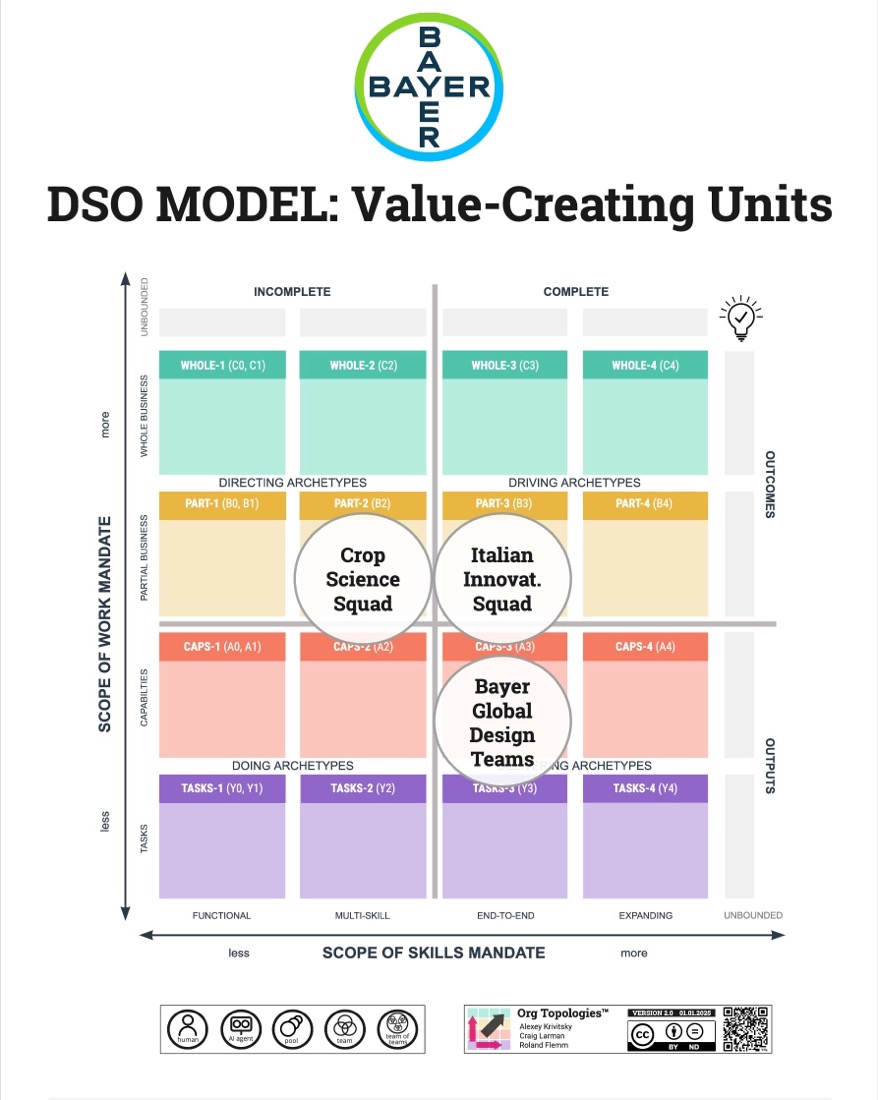
Similar to Haier's assessments above, below are the Org Topologies mappings for Bayer's sample value-creating units.
Bayer Crop Science Squad
- Horizontal: This cross-functional Multi-Skill squad (field sales reps, technical agronomists, customer advisors) combines diverse expertise to develop and execute market-specific solutions.
- Vertical: Focused on a specific segment within the crop science division (Partial-Business Focus), delivering targeted outcomes rather than managing an entire business.
Bayer Italian Innovation Squad
- Horizontal: This agile squad — drawing talent from R&D, design, and operations — was able to take a healthcare innovation (a tool for easier injections) from concept to market in 2–3 months, delivering a complete End-to-End solution.
- Vertical: The mandate is centered on a specific innovation project within the healthcare/pharma segment (Partial-Business) rather than an entire business vertical.
Bayer Global Design Teams
- Horizontal: Composed of multidisciplinary experts, these teams work on comprehensive process redesign and digital transformation, integrating a wide array of skills to deliver full solutions (End-to-End).
- Vertical: Their primary focus is on enhancing and optimizing operational processes (e.g., supply chain, digital workflows) rather than managing a complete business line — assessed as Capabilities Focus.
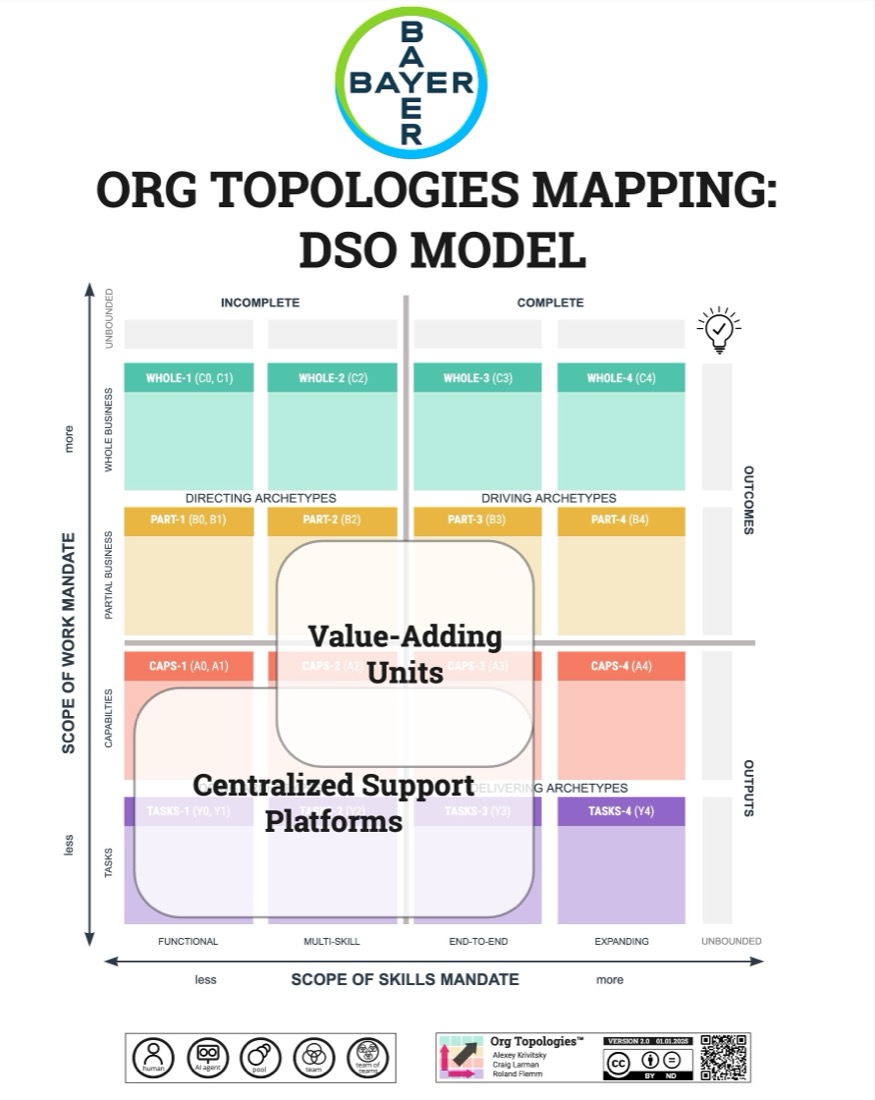
The visual representation:
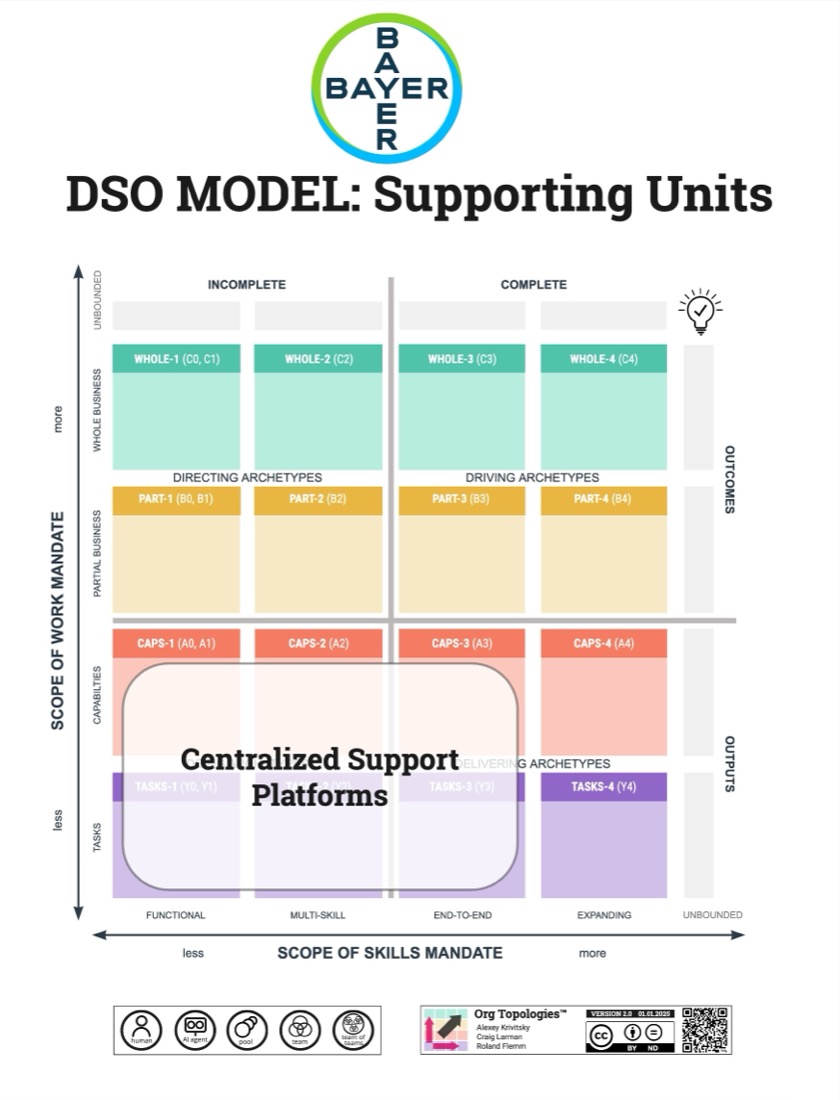
Below is the Org Topologies mapping of the sample supporting units of Bayer.
Centralized support platforms
- Horizontal: These platforms support the agile squads by delivering standardized tools, resources, and process frameworks that enable faster decision-making and smoother inter-team collaboration. That spans the whole range from Functional to End-to-End.
- Vertical: Placed in the Task Focus to Capabilities Focus range. Their work mandate is narrowly defined — they are responsible for specific support tasks or developing certain operational capabilities, not for managing a complete business or customer value chain.
Integration and coordination forums
- These are merely events and virtual teams, so we won't assess them.
And on the map:
6. Comparing and Contrasting the Two Models
Both Haier's micro-enterprises (MEs) and Bayer's agile squads are advanced work units — but they excel in different dimensions of organizational transformation.
Haier's micro-enterprises (MEs). These units are highly advanced in terms of decentralization and entrepreneurial empowerment. Each ME functions as an independent profit-and-loss center with full decision-making authority and direct customer engagement. Their structure not only dissolves traditional hierarchical boundaries but also integrates deeply into larger Ecosystem Micro-Communities (EMCs), enabling a near-seamless alignment between employee incentives and user value creation. This radical shift — where nearly all operating staff are treated as mini-entrepreneurs — is a breakthrough in dismantling bureaucracy and fostering sustained innovation.
Bayer's agile squads. Bayer's squads are advanced in adopting agile, cross-functional collaboration within a traditionally hierarchical, large multinational context. These squads (typically 5–15 members) are empowered to work rapidly and iteratively, leveraging digital collaboration tools to shorten decision cycles and respond to market demands quickly. Although they enjoy significant autonomy on project-specific tasks, they still operate within a framework that includes centralized support functions for strategic alignment and resource sharing. This approach excels in creating rapid, flexible responses but may not be as radically decentralized as Haier's MEs.
Both models rely on shared supporting units that enable the work units by offering standardized commodity services and platforms.
Managing Interdependency with Digital Contracting and Agile Coordination
MEs and squads can do a lot independently, yet they are interdependent and should not function as broader silos. They have to find ways to collaborate with each other. Here, Haier and Bayer apply different strategies.
Digital contracting is a cornerstone of Haier's RDHY, enabling its vast network of MEs to function as an integrated, agile ecosystem. Rather than relying on traditional, paper-based agreements, Haier employs digital contracting through platforms like COSMOPlat and the Workbench. These systems utilize smart contracts and blockchain technology to automate and secure agreements between MEs and their external partners.
When an ME issues a digital tender for a service or resource, competing units bid for the work; once agreed upon, the contract is automatically executed and recorded on a blockchain. This streamlines negotiations, minimizes errors, and ensures payment is directly linked to the value created for customers — embodying Haier's "paid by users" principle. In essence, while each ME operates with significant autonomy, digital contracting ensures they remain interdependent, sharing resources and expertise across EMCs.
In contrast, Bayer's DSO — which effectively operates as a Delivery Topology pushing toward Adaptive — addresses alignment and coordination among its agile squads through a set of complementary digital and procedural tools.
To manage dependencies across squads, Bayer employs agile ceremonies such as "scrum-of-scrums," where representatives from different squads meet regularly to synchronize efforts, resolve conflicts, and ensure alignment with the company's broader strategy.
Additionally, Bayer relies on digital collaboration platforms that provide real-time transparency through shared dashboards, performance metrics, and project updates. Dedicated liaison roles further facilitate coordination by managing inter-squad dependencies, ensuring overlapping resources and joint initiatives are effectively integrated.
In summary: Haier's digital contracting transforms micro-enterprises into semi-independent, entrepreneurial nodes that operate through automated, transparent agreements — ensuring that autonomy is balanced with ecosystem collaboration. Bayer's DSO emphasizes agile alignment among its squads through structured coordination mechanisms, digital tools, and dedicated liaison roles. Both approaches aim to dismantle traditional hierarchies, yet Haier's model focuses on creating a tightly integrated digital marketplace for value exchange, while Bayer's strategy is centered on aligning and coordinating autonomous teams within a larger corporate framework.
7. Putting It All Together
Haier's Rendanheyi, initiated around 2005 and refined by 2012, dismantles traditional hierarchies by reorganizing most employees into small, autonomous micro-enterprises that operate within an interconnected ecosystem. It decentralizes the organization into MEs that are integrated into a broader ecosystem through digital contracting and Ecosystem Micro-Communities.
On the horizontal axis (scope of skills mandate), these units are positioned as End-to-End to Expanding — they begin as end-to-end units but continuously acquire new skills and external capabilities via digital tools.
Vertically (scope of work mandate), some MEs (e.g., Smart Home Appliance or GE Appliances units) are mapped as Partial-Business because they manage the full value chain for a given product line, while others — like the Mask Supply Microenterprise — operate at a Partial-Business level, focusing on a specific product segment with some dependency on shared services.
In contrast, Bayer's Dynamic Shared Ownership — an ongoing roll-out started in 2018 — restructures the organization into agile, cross-functional squads that work rapidly on specific projects. Bayer's squads, supported by centralized platforms and coordination forums, are generally positioned as Multi-Skill units with a Partial-Business mandate.
On the horizontal axis, these squads generally fall within the Multi-Skill to End-to-End range, reflecting their integration of diverse expertise to rapidly deliver innovations and adapt to market feedback.
Vertically, the squads are mostly positioned in the Capabilities to Partial-Business zone, as they are tasked with delivering specific projects or capabilities rather than running an entire, standalone business. Bayer reinforces alignment and coordination through centralized support platforms and integration forums that help manage interdependencies among squads.
This article is a part of a series on Org Topologies — a map to make your agile transformational journeys thoughtful and continuous.
Alexey Krivitsky
Co-author of 10X ORG and co-creator of Org Topologies. Helps organizations rethink, redesign & rewire themselves for the AI era — from the codebase to the boardroom.

As a full-stack consultant, I operate across all three layers — AI Fluency, Team Flow & Org Fit. Talk to me to get a custom offer that matches your organization’s maturity to drive the impact.