In Search of Adaptivity Fit
TL;DR:Adaptivity costs real money: iterative practices, new roles, cultural shifts, consulting. Benefits are invisible at first. The default argument — our market is stable, we are fine — has two gotchas: stability is never permanent, and adaptivity compounds over time. Organizations are naturally adaptive until something internal starts impeding them.

Imagine an Adaptive Organization
This article is a part of a series on Org Topologies — a map to make your agile transformational journeys thoughtful and continuous.
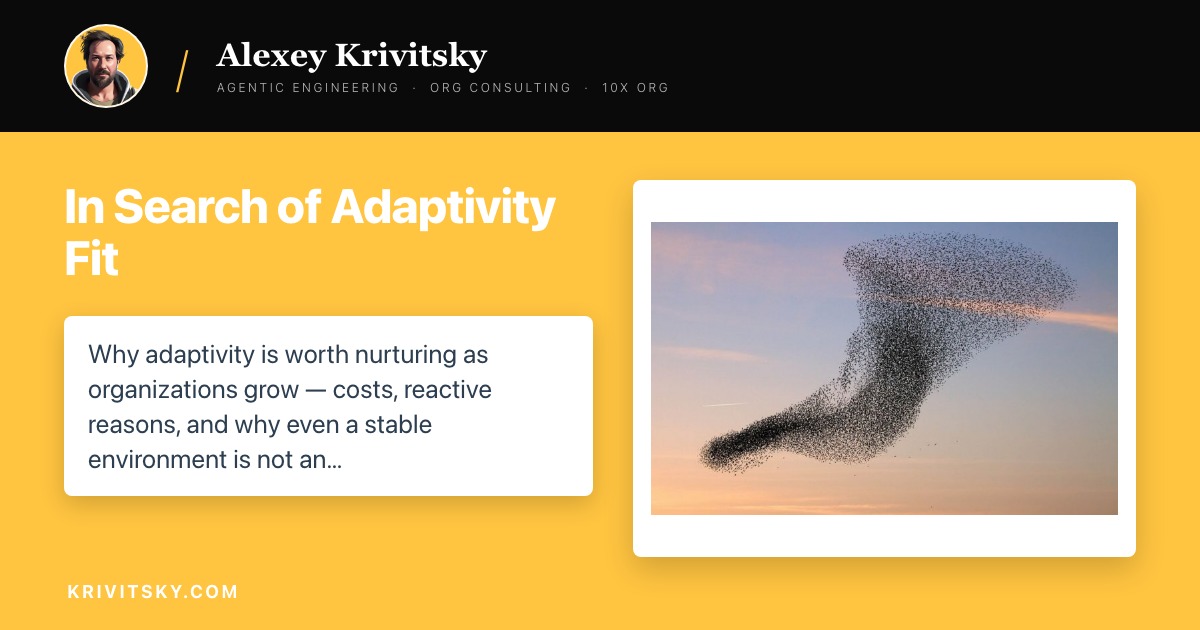
Can you imagine an organization in which, to adapt to a new strategy, one needs just to re-order items on a single organization-wide backlog? Wouldn't it be awesome if the entire organization would react like a living organism to a change in an environment — flex all the muscles, turn, and start immediately moving in the new direction?
Groups of people are inherently highly adaptive. A few weeks ago I was in the Alps looking for free-ride adventures. Our group had a leader and a rough plan of where to go and what to do. For several hours, we were having fun doing exactly what we were planning to do, but then the sun came out, the snow condition changed, and the risk of avalanches increased. So we moved to more northern-facing expositions, also staying at lower angles. That was a natural thing to do — to adapt.
Organizations (being groups of people) are adaptive too. By their nature. Think of this: at some point in time, a particular firm didn't exist. People who are now called the staff had been doing something completely different elsewhere. Then a business idea emerged, then the first team got assembled, and now we have these hundreds of people working there and everyone contributes to the value with her personal traits and skills. Isn't that miraculous?
Organizations can remain adaptive as they grow and mature — unless something from within starts to impede their ability to see and react as an organism to new information, to changes in the environment. These internal impediments often take the form of three contagious organizational diseases — silos, shrunken Scrum, and autonomy blockades.
So let's talk about how to nurture and preserve adaptivity as organizations grow. But first, let's consider why adaptivity is something organizations would want to pursue.
Costs of Adaptivity
When most agile consultants try to sell "agility" (meaning higher adaptability or better adaptivity) to organizations, they typically mean one key benefit it can bring: being able to change the course of product development when the market changes. That is a vital skill for an organization, won't you agree? So if it had come for free, everyone would have had it. But it comes with a price that contains several cost parameters:
- learning and mastering an iterative and incremental approach
- changing habits and policies to rely on empirical process control
- introducing new roles to sustain those new processes, like Product Owners, Scrum Masters, etc.
- and consulting to make it all work
So as you see, increasing adaptivity is not for free — it has its costs. And what makes it even worse, its immediate benefits are hard to see, as this is a long-term change that requires cultural and structural transformations.
This all makes it a tough sell from all sides: the promised benefits are invisible at a glance, but are already costly from the beginning.
So a strong argument against that change is likely:
"Hey, we don't need that because [pick an option that fits the context] a) our market is not changing that rapidly, b) our clients don't change requirements too often, c) we are in a stable niche, d) and we've been able to survive past course corrections. And we are just fine the way we are."
There are two gotchas in this thinking that I'd like to highlight:
- "Being fine" is fine — unless there is another company on the same market that is getting finer and starts beating you. So likely you don't want to be just fine based on your past standards; you probably want to be the best (or at least better than before) at what you're doing. And that requires constant work on yourself. A constant strive for perfection. A constant change in how you're running things.
- Even if you believe that you are in a relatively stable environment (congrats!) your plans might go south (oops!) because of planning and/or execution failures, for instance. And this is not intuitive: even when the surrounding environment didn't change a single bit, you might need to adapt and do course-correcting actions to improve execution that has gone wrong.
So there are at least two good reasons to consider wanting more adaptivity, even if it is not for free and the effects are not immediate. In the age of AI, this becomes even more urgent — AI-native startups moving at 100X are setting the benchmark your organization will be measured against.
Reactive Reasons to Adapt
There are numerous situations when an organization would benefit from being adaptive — to react to certain things:
- to changing market demands.
- to feedback on unchanged (but missed) requirements.
- to unfulfilled plans turned unrealistic.
- to discoveries that are more promising than the older ideas.
Notice that only the first case is about external change. The other three situations are caused by various inner forces: misunderstanding in requirements, failure in plan execution, and insight or learning that happened while correctly executing a good plan.
And from the list above, I bet, a sudden market-initiated change is the least frequent. So what does that mean? It means that being adaptive is vital, no matter whether you consider your environment stable or not. And this is without even taking into account the proactive reasons to be adaptive — the kind of multi-learning that turns teams into genuine problem-solvers rather than feature factories. But that's another story.
Alexey Krivitsky
Co-author of 10X ORG and co-creator of Org Topologies. Helps organizations rethink, redesign & rewire themselves for the AI era — from the codebase to the boardroom.

As a full-stack consultant, I operate across all three layers — AI Fluency, Team Flow & Org Fit. Talk to me to get a custom offer that matches your organization’s maturity to drive the impact.