When Contributors Are Complete (2/2): Extreme Cocreation and the Product Pulse
TL;DR:A guild of whole craftspeople produces privateers, not a fleet. The flotilla — guild plus shared intelligence — and the Product Pulse turn autonomous work into a shared direction.
In Part 1, AI made individuals whole again — the Super IC — and a collection of whole craftspeople turned out to be a guild. The guild gives them quality, learning, reputation, market access. But it left a gap: everyone complete, the output layer humming, and nobody converging on shared outcomes. Whole ships, no fleet.
So we ended on the question: what if alignment isn't something you impose — but something that emerges from structure? Here's the answer.
From Guild to Flotilla
Think about how a navy organizes its ships.
The battleship is the factory. One massive vessel, centralized command, everyone at a narrow station. The admiral commands every action from the bridge. Incredible concentrated firepower — but slow to turn, and if a torpedo hits the engine room, the whole thing sinks. This is the Resource Topology at sea.
The convoy is the agile organization. Ships in formation, each with a clear role and a clear lane. The convoy moves from A to B efficiently. But it moves at the speed of the slowest vessel. The escort can't suddenly carry cargo; the tanker can't fight submarines. When the route needs to change, the entire formation must turn together. This is the Delivery Topology — the Demand Ceiling on water.
The flotilla is something else. A fleet of small, self-sufficient vessels. Each one carries its own navigation, propulsion, communications, and armament. Not a miniature battleship — a whole ship, designed for independence.
The flotilla commander sets direction: "Control this strait" or "Find and engage the threat." Not "Ship 3, turn to heading 270, fire at grid reference 4-7." Each captain navigates their own water. They scatter when the situation demands it. They converge when mass matters. They enter shallow coastal waters the battleship can't reach.
What holds the flotilla together isn't hierarchy. It's shared intelligence. Common charts. Real-time signals. A shared understanding of the mission that makes coordination emerge from autonomous action rather than requiring it through command.
This is the Adaptive Topology at sea.
And the privateers — our guild without a flotilla — are whole ships without the shared intelligence layer. Each one is excellent. None of them converge.
The Platform of Shared Intelligence
The flotilla doesn't work because an admiral tells each ship what to do. It works because the infrastructure — shared charts, signals protocol, common mission brief — makes autonomous decisions converge by design. Alignment isn't imposed post-factum. It's baked into the conditions.
Haier figured this out at scale. Four thousand micro-enterprises, each autonomous, each capable of forming temporary partnerships. They don't have "aligned autonomy" as a management philosophy. They have a digital platform — shared data, user-facing metrics, contracting mechanisms, idea-pitching processes, time-bounded ventures. The platform doesn't tell micro-enterprises what to do. It creates the conditions under which their autonomous actions converge on customer value.
Software engineers will recognize this pattern instantly. AI-augmented craftspeople are microservices — self-contained, independently deployable, each owning its own logic and data. The guild is the service registry and shared protocols: health checks, quality standards, discovery. But microservices without orchestration produce chaos. Each service works fine in isolation; the user experience is incoherent. You decomposed the monolith — good. You forgot to build the platform — fatal.
Here the microservices analogy breaks — and that's the point. The platform that turns craftspeople into a flotilla isn't a piece of technology. It isn't Kubernetes routing traffic between services, and it isn't a tool that assigns tasks. Microservices coordinate by passing messages: each does its job, hands off the result, and never needs to understand the whole. People aren't like that. What connects whole craftspeople is shared understanding — a common read on the customer, the strategy, the stakes. And building that understanding is itself creative work; it happens when people think together, not when a system passes a message from one to the next. The platform is social before it is technical.
The guild addresses the broader discipline concerns: quality, learning, reputation, standards.
The platform of intelligence provides the immediate context: signals, metrics, dashboards, shared understanding, a space to cocreate, a human rhythm.
Neither is alignment-as-correction. Both are structural conditions. Together, they turn privateers into a flotilla — coherent enough to take on larger challenges, yet with the dynamic coupling and decoupling that lets fast, independent, AI-augmented individuals do their own work.
Extreme Co-Design
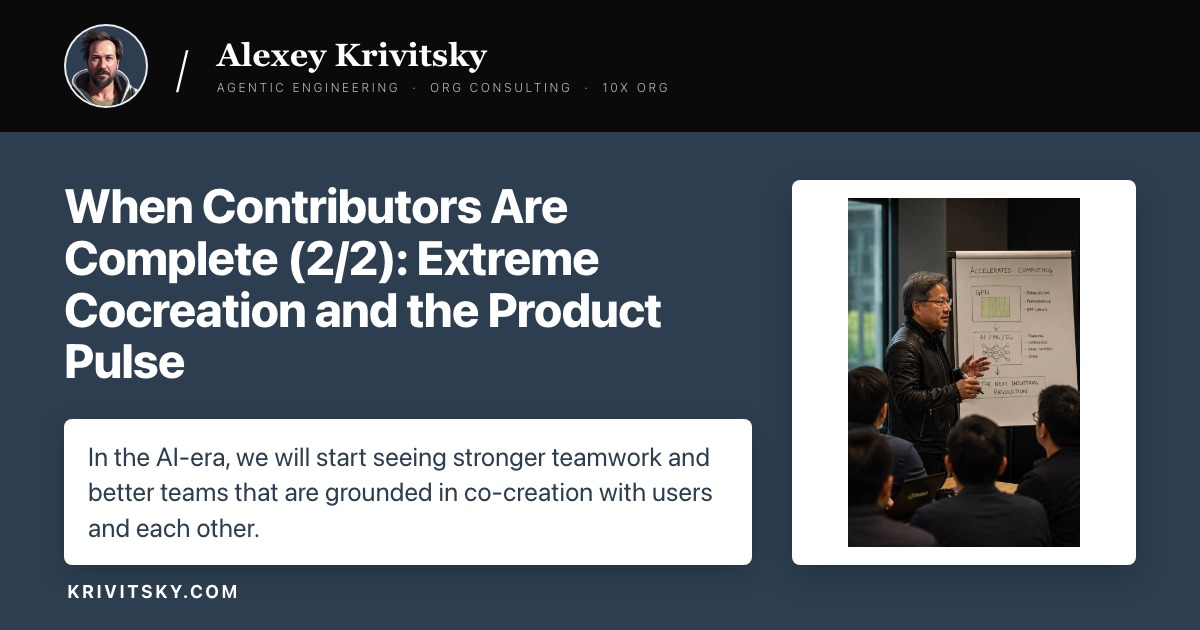
NVIDIA runs on something Jensen Huang calls extreme co-design. He keeps around sixty direct reports — no compact "leadership team," no cascade of intermediaries filtering the picture. The reason is structural, not stylistic: a modern GPU can't be optimized one layer at a time. Memory, compute, optics, cooling, networking, the software stack, and the algorithms running on top all constrain each other. Tune the silicon in isolation and you leave performance on the table at the system level. The only way to reach the global optimum is to co-design every layer at once — in the same room, with the people who own each layer fully present.
That is not coordination. Coordination is what you do with fragments: hand-offs, contracts, integration meetings to reconcile parts built apart. (A phased SDLC — even one called a sprint — does exactly this.) Co-design is the opposite — whole experts, each holding a complete perspective, working a problem whose constraints are too entangled to split first and assemble later. No single brain holds all the constraints at once, so you put all the brains in one room and let the design emerge from their collision.
This is the human shape of what AI now makes possible everywhere. Once individuals are whole again — augmented, end-to-end — gathering them isn't about filling skill gaps. It's about holding a constraint space no one of them can hold alone. That's what I call extreme cocreation: not the coordination of fragments, but the collaboration of whole craftspeople on a problem that demands multiple complete perspectives at the same time.
Recap: History Is Not the Past
Let me recap the evolution — and decomposition — of the craft as we've witnessed it so far.
- The Pin Factory shatters the craft — narrow tasks, specialists, hierarchy coordinates production (200 years) — and still wired into the management systems of most organizations today
- Agile teams reassemble fragments — the convoy. Cross-functional delivery, efficient in lanes, locked between them
- AI restores the craft to individuals — the guild returns. Whole craftspeople, but the organization hasn't caught up
- Guild alone produces privateers — the guild gap. Whole ships, no fleet. Quality and learning but no convergence on outcomes — a novel problem to have: before, we were too dependent and blocked; now we're free, roaming in different directions. New times, new problems
- The Product Pulse — when what the guild offers isn't enough for coherent work, Super ICs adopt a merge–diverge rhythm: merging is a short interval to slow down, talk, challenge assumptions, build joint theories, and prioritize — then they diverge again
The Pulse
Inside the flotilla, work follows a rhythm. Not permanent teams, not permanent solo work — a pulse.
Solo craft is the default mode. The augmented individual delivering end-to-end. This is where most work happens.
Co-design assembly kicks in when the problem exceeds one person's cognitive bandwidth — when the constraint space is simply too large for a single head. This is extreme cocreation in motion: whole craftspeople convening not to divide the work, but because the work can't be divided yet.
Decompose and return. After the co-design session resolves the constraint space, individuals take their pieces and execute in solo mode again.
Solo → gather → co-design → decompose → solo. The permanent team disappears. What replaces it is this rhythm — the pulse of the flotilla. Ships scatter, ships converge, ships scatter again. The stable structure isn't the formation. It's the fleet.
The word matters. Machines run continuous processes. Living things pulse. Heartbeat, breathing, circadian rhythm — biological systems alternate between states. Systole and diastole. Inhale and exhale. The pin factory never pauses; it's a process. The flotilla pulses; it's an organism.
The Product Pulse — an idea I first floated on LinkedIn — names the specific gathering triggered by outcome drift. When individuals are producing fast — AI-augmented, end-to-end capable — the output layer hums. But something starts to decay: the shared understanding of what customers are actually doing, what the business landscape is signaling, and where the product direction should actually go.
This is the Fabian problem: a team generating FOMO about commits, reaching for a "podcast of the commit log" to stay synchronized — when the real gap isn't what people built, but whether any of it moved the needle on customer outcomes. And it's the production-speed-outruns-alignment-speed problem: two rooms, one fast and one slow. The fast room builds while the slow room — strategy, customer insight, direction — tries to keep up, often failing to until alignment is forced at a code review or a sprint demo.
The Product Pulse closes this gap. Not by slowing the fast room down — by making the outcome layer keep pace. Complete workers bring what they observed in solo mode: a customer pattern, a business signal, an assumption that cracked under contact with reality. The group synthesizes it, the shared intelligence updates, and the fleet stays coherent. No manager required to translate between business and engineering; the people doing the work are close enough to the customer to read the signals themselves.
Lighter than a sprint review, more pointed than a strategy offsite. A recurring rhythm — the heartbeat of the shared intelligence layer that keeps the guild from fragmenting into privateers who each build brilliant things that never add up to a direction.
It's not another meeting to restore lost alignment. It's a platform that makes autonomy valuable — the structure that ensures individual capability adds up to something.
Without it, whole individuals become privateers — brilliant, fast, each sailing in their own direction. The pulse is the force of gravity that turns them into a fleet. A powerful flotilla that follows the wind — together, in the same chosen direction, exploring new lands, hunting for treasures, and showing the best of joint intelligence.
We Don't Need Teams Anymore, Right?
Not quite. That's a false choice.
There are times when you need to work alone — and now, because we can be complete at solving customer problems end to end, there will be more of them. Individual contributors will increasingly enjoy solo problem-solving: the whole person, close to the customer, the distance shrunk to zero. This is what Scrum and XP were reaching for all along.
But if the product is bigger than any one person's contribution, there will still be important moments when the team gets together — not to coordinate work or untangle dependencies (those barely exist anymore), but to address common concerns, discuss business, share what they've learned, work through the hard challenges, and arrive at a joint strategy.
I claim that in the AI-era, we will start seeing stronger teamwork and better teams.
When everyone is a complete craftsperson with a strong connection to the reality (users, market, feedback), the team becomes a home for group intelligence——the place of co-creation and learning.
Missed the setup? Start with The Super IC Trap and the Guild Hypothesis (1/2).
Alexey Krivitsky
Co-author of 10X ORG and co-creator of Org Topologies. Helps organizations rethink, redesign & rewire themselves for the AI era — from the codebase to the boardroom.
As a full-stack consultant, I operate across all three layers — AI Fluency, Team Flow & Org Fit. Talk to me to get a custom offer that matches your organization’s maturity to drive the impact.