AI-Supported Org Design
TL;DR:AI OD is the strategic use of AI to evolve how organizations are structured and how people learn. Two anchoring principles: AI makes versatile teams viable by collapsing the cost of learning adjacent skills, and multi-learning becomes the engine of continuous adaptation. This is not a productivity story — it is an org design story.
A larger landscape than individual productivity
AI, of course, can be used to improve the performance of individual single-skilled specialists, and this is what we see as of 2025 — but as the Ferrari Trap shows, faster individuals in unchanged structures produce no system-level gain. There is a much larger landscape. Let me share.
AI-Supported Org Design — AI OD for short — will become a hugely impactful topic affecting all of us and all the organizations in which we work.
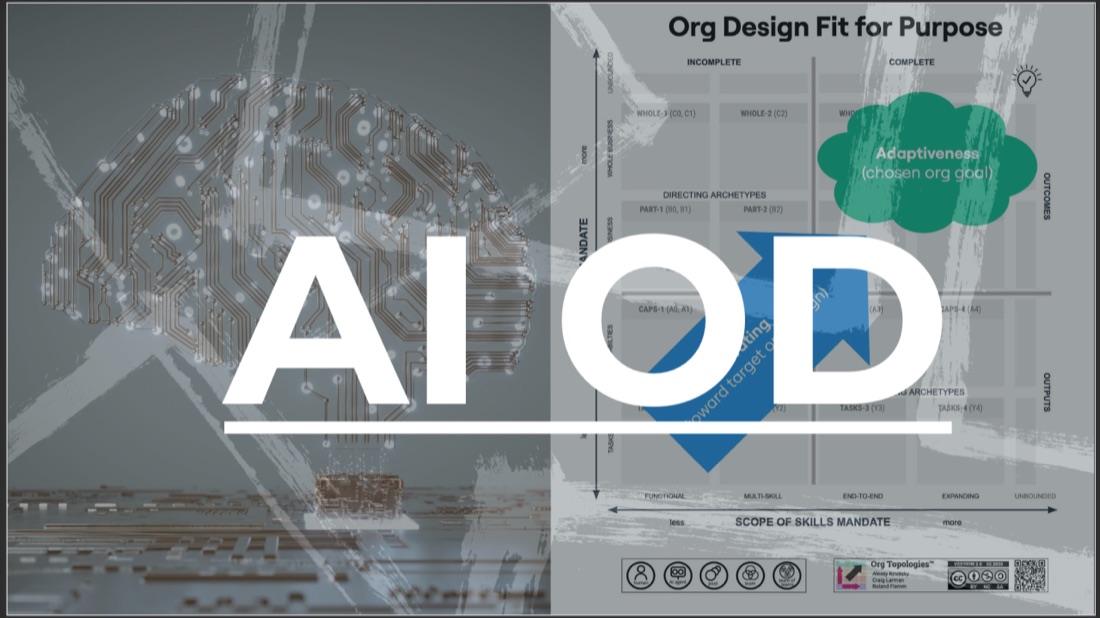
AI OD is the strategic practice of applying AI (agents and other upcoming innovations) to continuously inform, accelerate, and personalize how an organization is structured, how it evolves, and how its people learn.
It is not about replacing managers or employees. It is about empowering us to design adaptable, resilient orgs with fewer structural overhauls and more intelligence baked into the day-to-day.
Two principles anchor it:
- The core organizing principle: AI makes versatile teams viable.
- The core operating principle: With multi-learning as the engine.
How do these principles differ from applying AI for individual performance gains? Let me unpack.
Organizing principle: AI makes versatile teams viable
Most organizations are still designed around narrow specialization — single-skill roles, component ownership, hand-offs between functions. That design made sense for 200 years of factory logic, when learning a new craft was slow and expensive.
AI changes the economics of learning. When an AI agent can teach a backend developer the basics of customer support flow, or walk a support agent through writing a Python script, the cost of acquiring adjacent skills collapses. What used to require a re-org now becomes a learning act inside the team.
That is what unlocks versatile teams — teams broad enough to follow the work end-to-end, with AI as the always-available teacher and accelerator.
Operating principle: with multi-learning as the engine
If we unpack this principle, it is all about applying AI to support the organization's development direction and accelerate its evolution to gain high performance and other competitive advantages.
That is strategic AI application.
Three sub-principles guide it:
#1 — Multi-learning enables adaptivity
Especially in Adaptive Topologies (see the Org Topologies primer for details), learning — not just delivery — is the primary currency. AI enables this by making the unknown known and the unlearnable learnable, with ease.
Sample scenarios:
- A backend developer shadows a customer support session and begins contributing to onboarding scripts.
- A frontline support agent learns enough Python to automate common diagnostic steps, reducing ticket escalations and easing the load on developers.
- An end-to-end team includes privacy review and data protection steps in their regular sprint workflow — not because they were forced to, but because someone on the team got curious, shadowed legal, and brought that knowledge back in.
- A delivery manager starts using AI tools like Cursor or GitHub Copilot — not to replace anyone, but to better understand how her teams are using it, what it is good at, and the current limits.
#2 — Matching work to skill in real time
Rather than static org charts or disruptive reshuffles, AI supports the continuous alignment of skills to work based on live data and evolving interests. When multi-learning is too expensive, AIs will suggest micro-reteaming without major upheaval as a temporary, quick-fix solution.
- Static matching: pre-analyze and pre-plan work.
- Dynamic reteaming: reallocate people when needed.
- Multi-learning: give people the mandate to learn.
When multi-learning is a part of work, managers do not need to waste time and energy preplanning or reteaming. People can follow the work and learn what is necessary to achieve the expected outcomes. This is the organizational capability that makes both wings of a 10X organization work.
#3 — Learning becomes the flow
AI agents will surface relevant prior work and recommend five-minute learning prompts when patterns emerge.
"Team X solved this two sprints ago."
"Want to see how testing was solved in a similar sprint?"
That is learning embedded in the flow of work, not pulled out into a separate training program.
Strategic AI in org design
AI-powered org design harnesses AI to make teams inherently versatile and learning deeply integrated — driving adaptable, resilient organizations without the need for constant structural upheaval.
This requires practicing a new mindset: seeing AI not as a tool to output more, but as a strategic lever that enables humans with easier multi-learning and higher outcomes.
AI OD is not a productivity story. It is an organizational design story — with AI as the amplifier of human adaptability.
That is what Org Topologies offers as a field guide for leaders in this disruptive era of AI we all happen to live in, in collaboration with Roland Flemm and Craig Larman.
Alexey Krivitsky
Co-author of 10X ORG and co-creator of Org Topologies. Helps organizations rethink, redesign & rewire themselves for the AI era — from the codebase to the boardroom.

As a full-stack consultant, I operate across all three layers — AI Fluency, Team Flow & Org Fit. Talk to me to get a custom offer that matches your organization’s maturity to drive the impact.