Why Scrum Is Silent on Team Leads

TL;DR:The Scrum Guide does not mention Team Leads — and that silence is intentional. The role is not relevant to Scrum. But it is present in your system and cannot be ignored. The real issue is not the title but the leadership style: whoever holds power over technical decisions shapes how the team self-organizes, or fails to.

Did Scrum Forget to Mention Team Leads?
Just reread the Scrum Guide. Still no updates. Not a word on this subject.
The only occurrences of the root lead are these two:
"The Scrum Master is a servant-leader for the Scrum Team."
"The Scrum Master… leading and coaching the organization in its Scrum adoption."
The reason the Scrum Guide isn't mentioning this commonly seen role is probably because it isn't relevant to Scrum. I guess this is true.
But it can be of your high relevance when it comes to a Scrum adoption — because this role is most likely present and is part of the system you're working in. So it can't be ignored.
Today on my CSM class (surprisingly full of Team Leads) I got surrounded by them, seeking the truth. They wanted to know: how do I see this role fitting with Scrum organizations?
When I ask for a definition of the role, in most cases it is something like:
"Be responsible for the overall technical excellence and development of the specialist group."
It can be less or more verbose, but in the end it boils down to certain power in someone's hands in making decisions that affect how the team does what it is supposed to do.
My Insight (It Is Never Too Late to Be Enlightened)
I started to remember all the team leads I've worked with. And also the strong individuals who shaped the teams I was working with. And then it struck me.
I remembered a guy who was not formally a lead but rather one of the oldest developers (by oldest I mean he made the first commit) — and how bossy he was with the others.
And then I remembered a recent example of a formal team lead who was very gently querying others' opinions and bringing teams to consensus whenever possible.
It is not about titles and roles. It is definitely about the level of personal growth and leadership style. And we all have one.
Leadership Maturity
Recently I got lucky to be introduced to Pete Behrens and his work on Agile Leadership. Pete uses the following diagram (not sure who originally invented it) representing the growth of a leader: from an expert (doing all on their own), to an achiever (making things done by influencing others), to a catalyst (empowering others to take actions and lead).
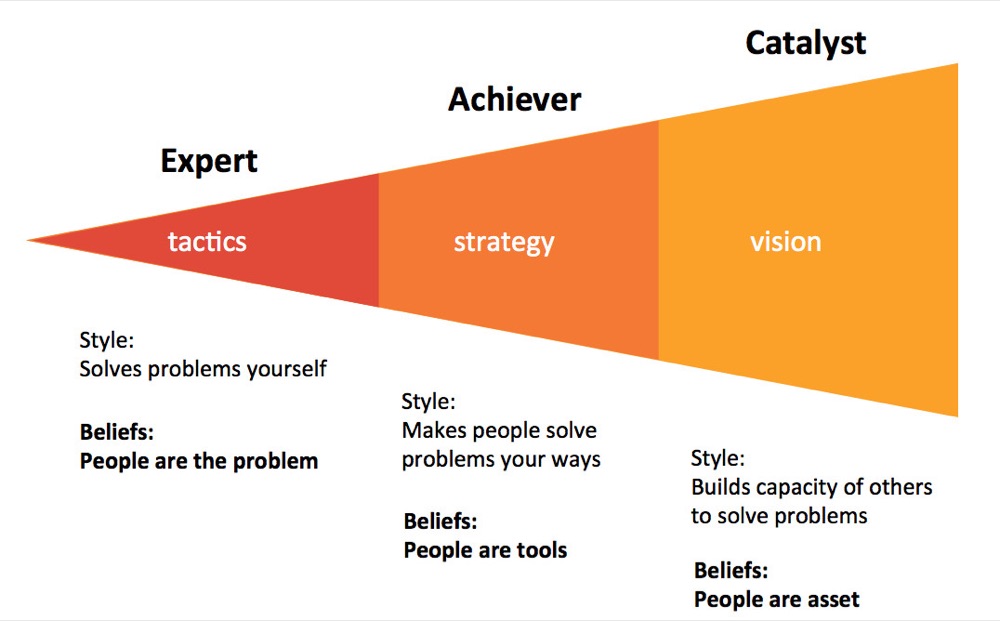
A technical expert: — I've coded this framework the other night. Integrate it.
A technical achiever: — We need a new framework. I believe Max and Alex are the best people for this job.
A technical catalyst: — Let's sit together and see how we should evolve our frameworks. I gave it a thought, but I'd like to know your opinions so we can make a decision.
Anyone Can Be Bossy (But No One Should Be)
If the threat of ruining a team's self-organization by being bossy can come from any direction, then we — team coaches — need to watch out for these behaviours from everyone on the team. And then train, mentor and coach team members in proper leadership style.
So I'm not concerned any more with specific roles like Team Lead, Tech Lead, Team Coordinator, Delivery Manager, Engineering Manager and so on.
Roles are secondary. Personalities are primary. It will be specific people helping or jeopardising your Scrum adoption. So forget about the roles. Work with the people. This is fundamentally a question of reactive vs. creative leadership — fear-driven control versus purpose-driven trust. For a structural take on why the team lead role keeps appearing, see Extract Team Leads.
Alexey Krivitsky
Co-author of 10X ORG and co-creator of Org Topologies. Helps organizations rethink, redesign & rewire themselves for the AI era — from the codebase to the boardroom.

As a full-stack consultant, I operate across all three layers — AI Fluency, Team Flow & Org Fit. Talk to me to get a custom offer that matches your organization’s maturity to drive the impact.