Org Design Defines Managers' Scope
TL;DR:Org design dictates what kind of management is possible. Weak teams force managers into micromanagement — task breakdown, assignment, control. Strong cross-functional teams enable macro-management — strategy, stakeholders, value. Coaching product management without fixing org design first is futile. Structure enables or prevents the role.
The role you can play depends on the org you're in
Have you ever tried coaching product management in an organization with no teams? It won't work, whether you call someone a 'product owner' or not. They won't be able to fulfill that role. But why?
Because organizational design defines and dictates the scope of work for the managers. So if you're a manager with no teams or in an environment with weak cross-functional teams – you will have no choice but manage for the teams. Micromanagement will be your daily job.
In contrast, if your teams are full-stack teams and even understand their shared work, there you as a manager will be able to do some true high-level management. Macro-management will be your playfield.
Micromanagement vs. macro-management
And it is not that micromanagers are worse than macro-managers. No, this is not what I am implying. But the impact that you can make as a manager will be different depending on which type of management you are allowed to do.
And the type of management you can do – that will be dictated and enabled by the org design you're in.
Consider the diagram below:
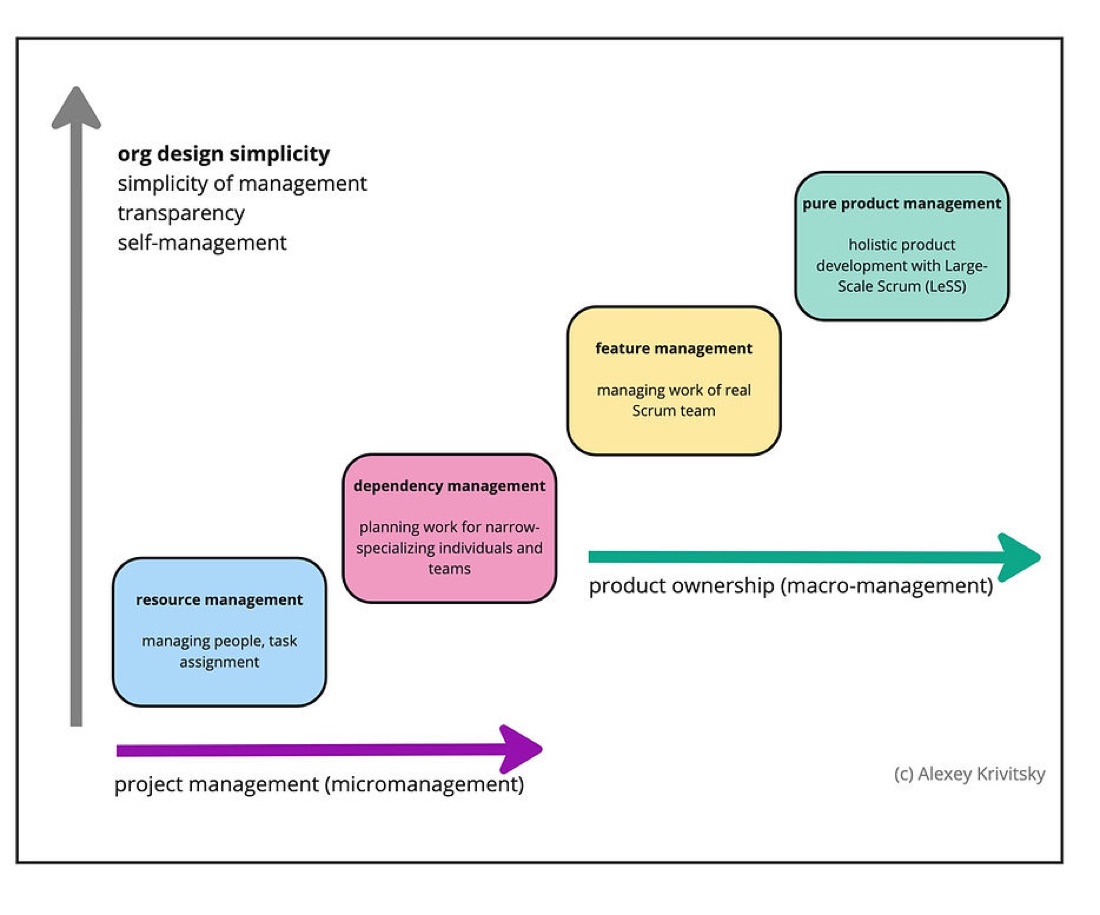
This scheme above is a derived and simplified version of the seven archetypes of Org Topologies.
The higher the org design simplicity (vertical axis), the higher the level of management possible (horizontal axis): from project management (aka micromanagement) to product ownership (aka macro-management).
The micromanagement side
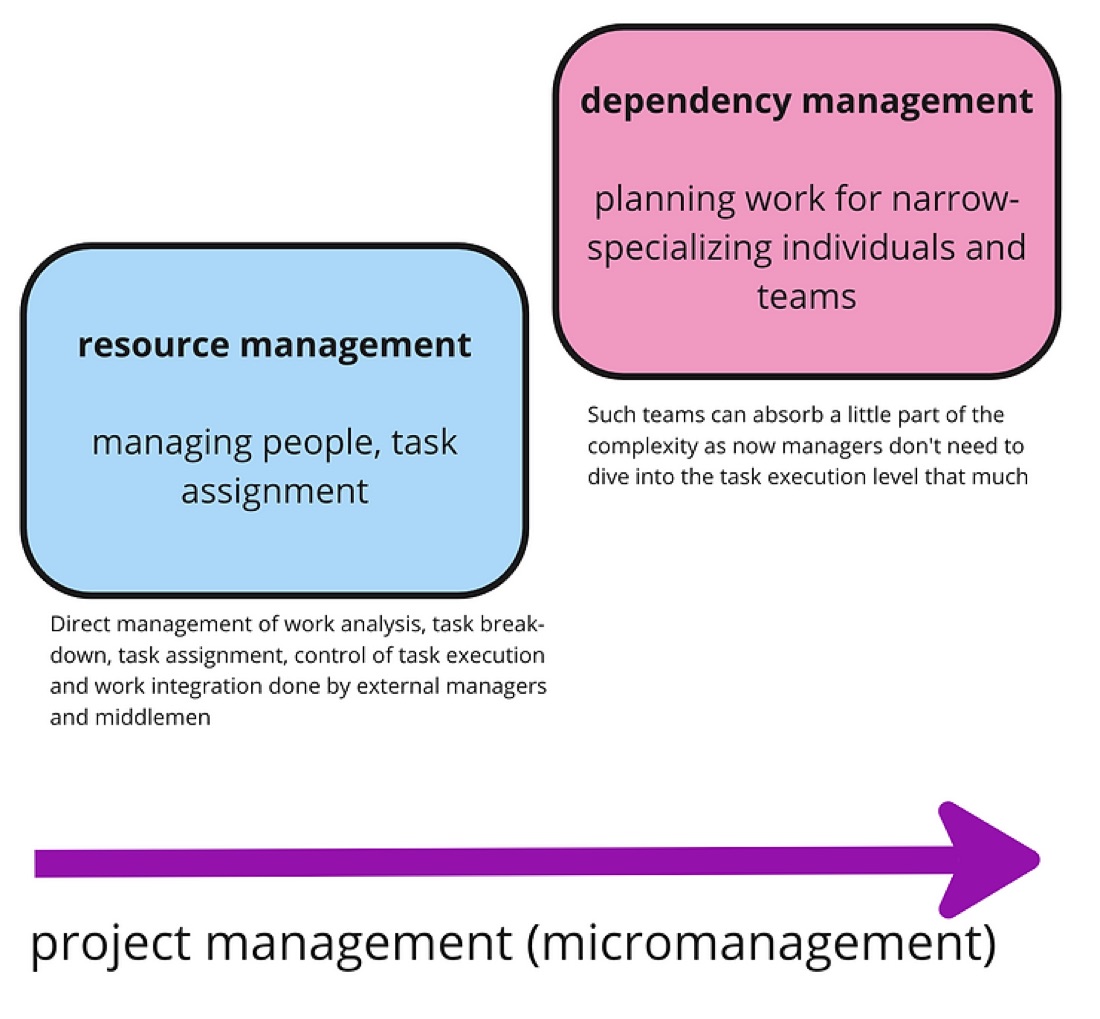
On the micromanagement side, managers spend their days on:
- Resource management — direct management of work analysis, task breakdown, task assignment, control of task execution and work integration done by external managers and middlemen.
- Dependency management — planning work for narrow-specializing individuals and teams. Such teams can absorb a little part of the complexity as now managers don't need to dive into the task execution level that much.
The macro-management side
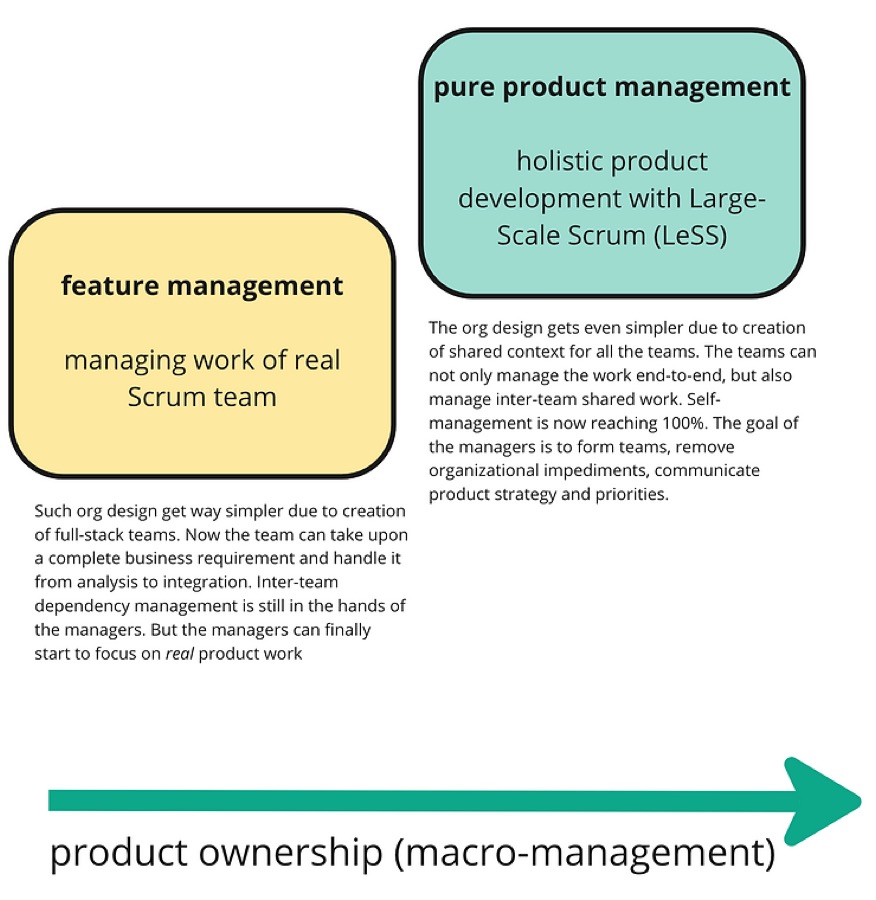
On the macro-management side, the picture changes:
- Feature management — managing work of a real Scrum team. Such org design gets way simpler due to the creation of full-stack teams, as described in Three Ecosystems of Product Development. Now a team can take upon itself a complete business requirement and handle it from analysis to integration. Inter-team dependency management is still in the hands of the managers. But the managers can finally start to focus on real product work.
- Pure product management — holistic product development with Large-Scale Scrum (LeSS). The org design gets even simpler due to the creation of shared context for all the teams. The teams can not only manage their work end-to-end, but also manage inter-team shared work. Self-management is now reaching 100%. The goal of the managers is to form teams, remove organizational impediments, communicate product strategy and priorities.
Start with the org, not the class
So if you want to pump up your managers to get better at product management – start with your org design. The structural path is laid out in detail in Elevate Product Management. Don't start with a product management class (even with such a great one as my CSPO class), there will be no use for that.
Therefore, before teaching your product managers agile and hiring them a coach – create the right environment, consider a correct org design where teams will be able to absorb as much complexity as possible. Extracting team leads is one structural move that frees up this space. Then your product management will flourish.
Alexey Krivitsky
Co-author of 10X ORG and co-creator of Org Topologies. Helps organizations rethink, redesign & rewire themselves for the AI era — from the codebase to the boardroom.

As a full-stack consultant, I operate across all three layers — AI Fluency, Team Flow & Org Fit. Talk to me to get a custom offer that matches your organization’s maturity to drive the impact.