No. Not Everything Is A Product
TL;DR:Calling everything a product — value streams, components, platforms — inflates complexity instead of reducing it. Each 'product' spawns its own strategy, roadmap, PO, and teams. The more narrow products you define, the harder it becomes to manage the whole. You end up with portfolio management overhead and near-zero adaptiveness.
I would like to reflect on a webinar by Dave West on Product Definition. More than a thousand people watched on the spot — so, an important discussion.
First of all, I appreciate Dave's involvement in the field as a subject-matter contributor. Being a CEO, he doesn't need to do this. But he seems to be driven by true passion, and it is fantastic to see this energy. I wish other certification bodies had such a leader!
Secondly, Dave's definition of a product as an "abstraction of complexity" that contains multi-dimensional interests, investments, and opportunities is a useful one. The contrast of project vs. product model that he drew on his talk was well thought of.
But! Here comes my analysis of the key idea of the talk:
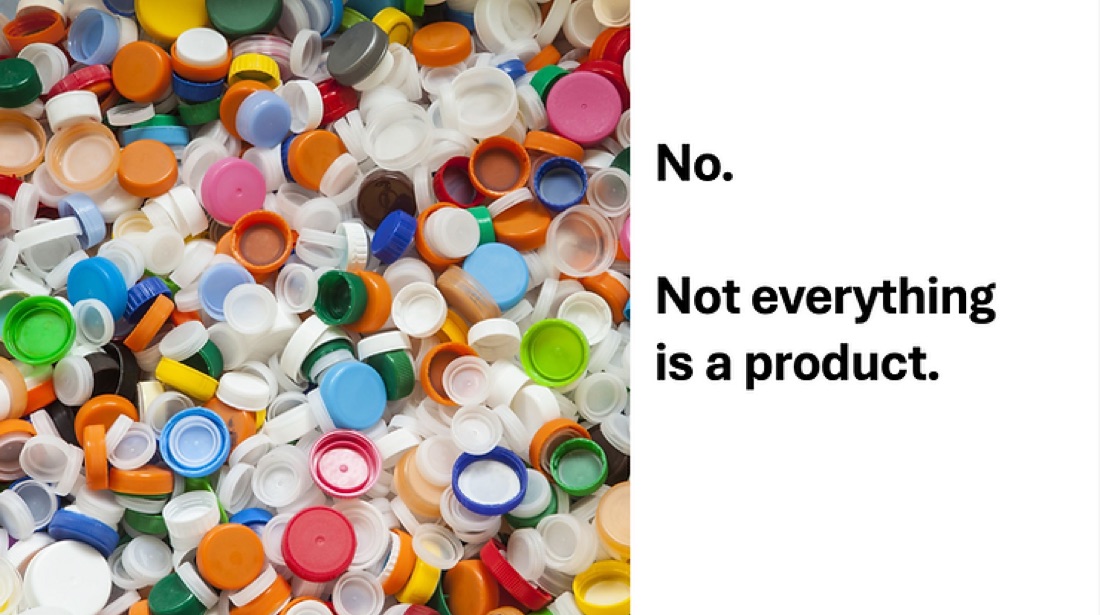
I CANNOT AGREE THAT EVERYTHING IS A PRODUCT.
Just the other day I listened to John Cutler's podcast where he clearly articulated that "no, not everything is a product."
One can apply product thinking to a problem space — including seeing organizations and org change as a product.
But!
IT IS DANGEROUS TO SEE EVERYTHING AS A PRODUCT INCLUDING VALUE STREAMS, INTERNAL COMPONENTS AND PLATFORM DEVELOPMENT.
Do I have a few more available characters in this post to explain?
If everything is a product, then:
- everything has its strategy, investments, roadmaps, product owners, teams…
- everything is a thing of its own
- everything is boxed with strict boundaries
- everything is siloed
- everything needs to be managed separately
As a result:
THE MORE "PRODUCTS" ARE DEFINED, THE HARDER IT IS TO MANAGE "THE WHOLE."
This is not a black-and-white discussion. But we need to understand the dynamics of our decisions.
Such org design with many narrow products will inevitably lead to increased complexity, the need for portfolio and dependency management, an army of product owners, coordinators, specialized teams, scrum masters... A lot of self-inflicted complexity and a very low level of adaptiveness — the same dynamics behind premature platformization.
Imagine what needs to happen when this org needs to be reconfigured to fit a change in the strategy or in the architectural approach? Difficult, expensive, slow. Low overall agility.
To conclude: it is vital to lead this discussion on product definition. And it is no less important to raise it beyond the industry status quo and easy solutions.
A product model is a good start but offers no perfection state. We need a holistic product model — what I'd call a whole product focus approach. Something to strive toward and get constantly challenged in our human, local thinking.
These are just my thoughts. 💭 Happy to discuss.
Originally posted on LinkedIn.
Alexey Krivitsky
Co-author of 10X ORG and co-creator of Org Topologies. Helps organizations rethink, redesign & rewire themselves for the AI era — from the codebase to the boardroom.
As a full-stack consultant, I operate across all three layers — AI Fluency, Team Flow & Org Fit. Talk to me to get a custom offer that matches your organization’s maturity to drive the impact.