Cat Paw Management (Meets Recession)
TL;DR:Teams narrowly specialized in low-priority features — the 'cat paw' teams — get cut first when recession hits. Narrow specialization creates overproduction: teams keep polishing their corner because that is all they can do. In a downturn, if your team's work is not a top business priority, you are exposed. Broader skills are job insurance.
The cat paw feature
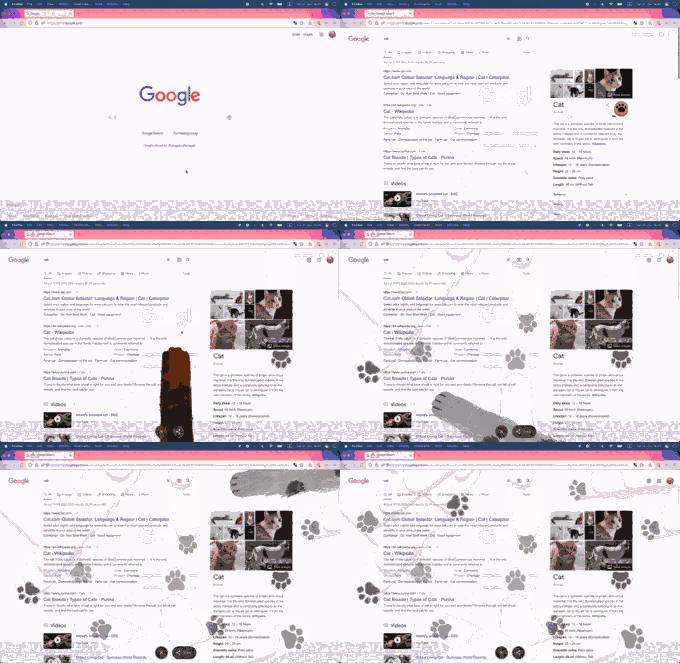
Did you see this Google feature yet? Type 'cat' or 'dog' and watch the search results page erupt in an expensive paw-prints animation:
I never knew of this feature, before I encountered this tweet:
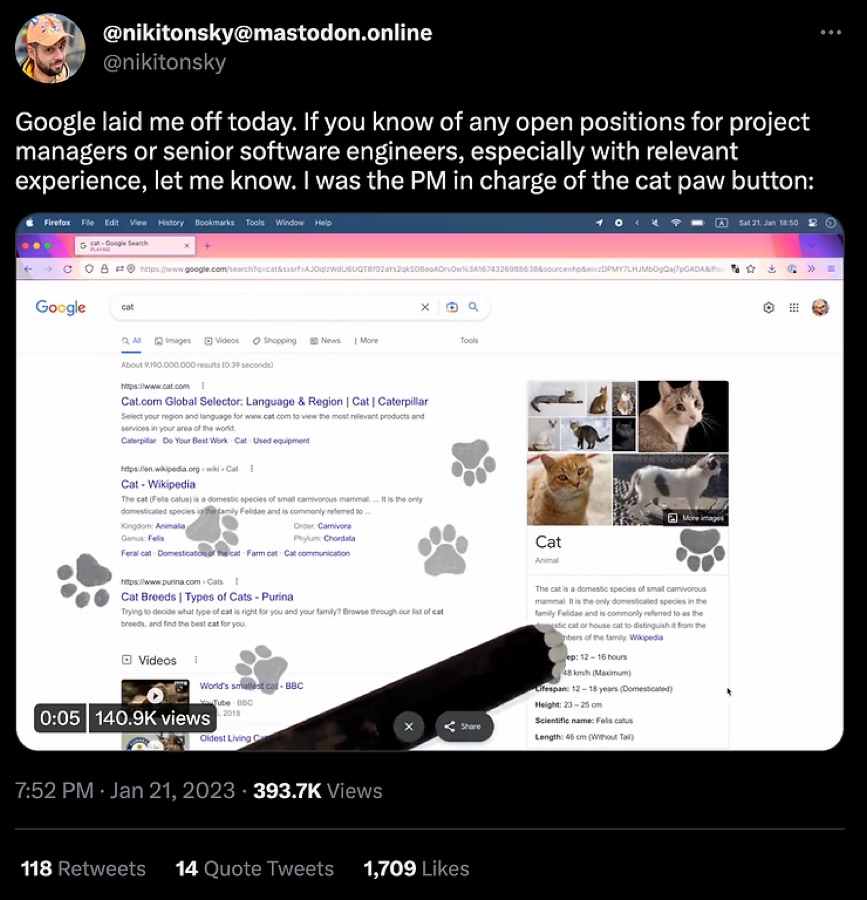
Although this tweet appears to be a joke, it highlights an important issue of the software product development industry that can't be ignored — in the face of the recession, the time of cat paw development is over.
Below are my thoughts on what's making this a real issue (for product development companies and their employees) and what needs to change to overcome it.
Overproduction and running costs
First, some essential definitions.
Overproduction (producing more goods than customers need) is one of the essential wastes classified in lean thinking, together with defects, inventory, hand-offs, over-processing and others.
It is a clear sign of process inefficiency. And overproduction itself causes other wastes: inventory of unsold goods grows, as well as the number of hidden defects in unused products.
We don't really know if the discovered 'cat paw' Google feature is more of a pet project. Or if there is a 'cat paw feature team' standing behind this piece of creativity.
What we know is that any live product feature draws maintenance costs, and this must be managed in some way. So eventually, it must be an organizational decision at Google to have cat paws built and kept running.
We like humor. And the cat paws are a good one. It also shows the customer how rich Google is and how much slack time it can afford. Following this logic, every company should want to have some form of cat paws in their products.
Narrow specialization and unwanted cat paws
Imagine there is a team in your organization that is specializing in some sort of customer feature. Something serious and not pet-related. For instance, cross-website search and product recommendations.
A long time ago, there was no search and no recommendations, and then the company recognized the potential in increasing customer activation, retention and life-time value with these features. So to have a laser-sharp focus on this development, a 'search-and-reco' team was created. And since then, they have been keeping these functions alive and modernized.
Five years later, that team is still there. Polishing the feature, fixing rare bugs, timely upgrading the technology, adding bells and whistles — keeping themselves busy and staying narrow-specializing. This is what happens when the scope of skills mandate is too narrow — the team can only do one thing, so that's what they do.
To follow today's wide-spread misinterpretation of Scrum, that team is likely to have a dedicated 'search-and-reco' backlog owner who makes sure that the team has things to do. Interestingly, when such a constellation is set, that team will always believe that they are working according to the priorities. So, all Scrum checks are green.
But wait a minute, are they? And how is this really different from the cat paw feature that seems rather important for someone at Google to invest in it? But at the same time, from the viewpoint of the company's global priorities, it practically adds no value (but just draws costs):
- Google shares lose $100 billion after company's AI chatbot makes an error during demo
- Some shareholders are concerned that Google's parent company is falling behind Microsoft in the AI race
What would be the best way for the cat paw developers at Google to stay relevant? Can they get retrained to help their company in the AI survival challenge?
And can the developers from our imaginary 'search-and-reco' team learn to work on something of higher value to stay relevant for their company?
Staying relevant (as a company and an employee)
On Friday, January 20, 2023, Alphabet, the parent company of Google, sent a memo written by chief executive Sundar Pichai announcing that 12,000 employees would be laid off.
Google is not the only company that lays off massively these days. We are clearly feeling an early wave of the upcoming recession. We can only hope it won't be deep and long. But hope is a poor strategy.
And companies found a way to deal with it — laying off their employees. OK, Google! That's your strategy to decrease cash burn rate and keep staying relevant. We got it.
A rhetorical question here is: who will Google fire first — a cat paw team or an AI search team? The answer is painfully clear.
So, what about us — employees of software product firms and other businesses? How can we stay relevant in the face of the crisis today and in general? (Crisis just makes societal and economic problems more tangible; the issue has been here for a long time.)
Well, our advice is to watch for the cat paws. Meaning: if you believe that you are working on something of a low priority from the global viewpoint — don't wait. Those times of relaxed feature polishing are over. We are sorry, but you can be the next one out. And this is not a threat, but a reality.
So, what can you do? Raise your concerns: don't hide, show that you care about the company's future. Raise your head and see around: stop developing the next version of the improved cat paws and start learning what's relevant for your company's business today and tomorrow. The answer is multi-learning — broadening beyond a single craft. With AI, this has never been more feasible.
Alexey Krivitsky
Co-author of 10X ORG and co-creator of Org Topologies. Helps organizations rethink, redesign & rewire themselves for the AI era — from the codebase to the boardroom.

As a full-stack consultant, I operate across all three layers — AI Fluency, Team Flow & Org Fit. Talk to me to get a custom offer that matches your organization’s maturity to drive the impact.