Agile Was Homework, AI Is the Assignment
TL;DR:You could fake agile for a decade — rename roles, run ceremonies, call it transformation. AI-native startups shipping at 100X just made faking visible. The gap is public now, and the structure of your organization determines which side of it you land on.
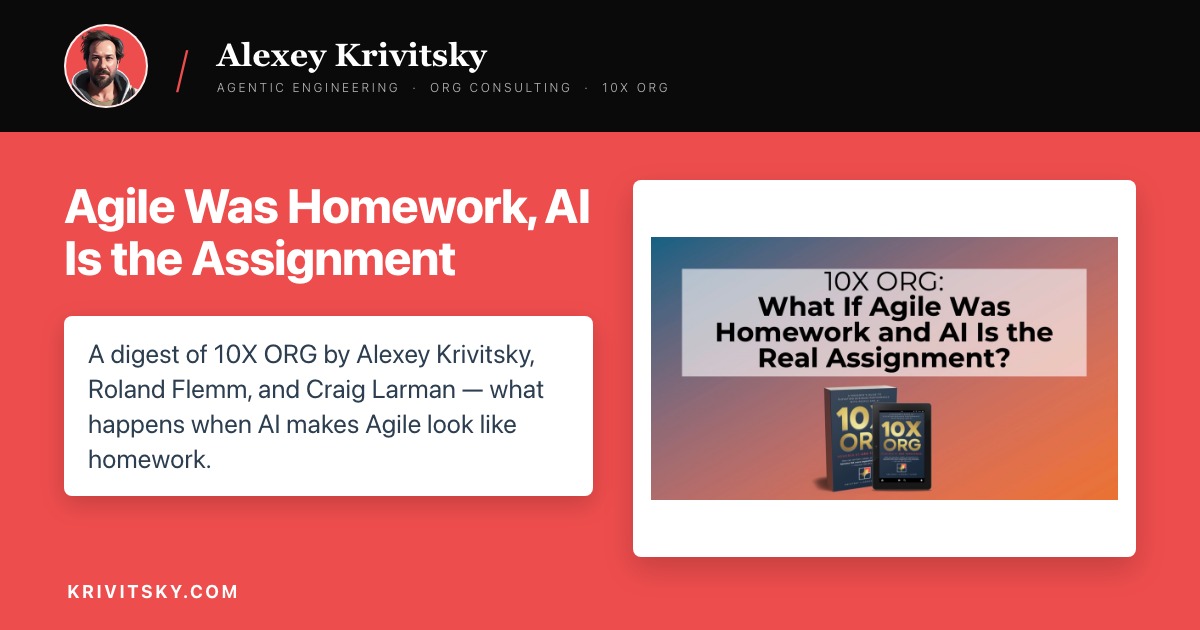
This is a digest from the ideas explored in 10X ORG by Alexey Krivitsky, Roland Flemm, and Craig Larman — a book about what happens when AI meets organizational structure, and why the structure usually wins.
Listen as a podcast:
You could fake agile...
Many did. You could rename your project managers to Scrum Masters, your status meetings to standups, your milestones to sprints. You could buy SAFe licenses, certify 200 people, hang a Kanban board in the hallway, and call the whole thing a transformation.
And it worked — in the sense that nobody called you out. The board saw the slide deck, the consultants got paid, the teams did their retros. Everyone played along. Change theater, done well, can run for a decade.
Your Scrum Master would have told you that's fine. "Agile is an adjective," they'd say. "What matters is that we're more agile this year than last year." And that sounded reasonable, because slow change was tolerable. The market moved at a pace where incremental improvement felt like enough, and nobody was keeping a public scoreboard of how fast your competitors shipped.
But here's the thing about slow change: in most organizations, it was cover for no change at all. The language got better. The ceremonies got smoother. The underlying structure — who decides what, who learns what, who is allowed to work on what — stayed exactly where it was.
That was survivable. Until now.
You Are Now Being Compared to 100X
AI-native startups are building full products with one CEO and five Mac Minis. They don't need your org chart, your review cycles, your handoff protocols. They started clean, with no legacy structure and no historical management system weighing them down.
From now on, your organization will be benchmarked against what they can do. Not by you — by your board, your investors, your competitors, your customers who notice that someone else ships in days what you deliver in quarters. One hundred times faster, and not as a metaphor. As a measurable gap.
So your leadership will ask — if they haven't already — why can't we move like that? And why do we see only costs increasing with no visible gains?
The answer is uncomfortable. Your organization didn't start from scratch when AI arrived. It was already on a path — a management system, team structures, habits built up over years. AI found all of that in place, and it is very likely your org is on the same trajectory as before, now with AI spread like fairy dust. Increasing costs, not necessarily gains.
With agile, you could hide in the theater. Fake a transformation, skip the hard parts, and nobody benchmarked you against a fundamentally different kind of organization. With AI, the 100X baseline is public. The gap is visible, and faking it gets expensive fast.
The Part That's Already Happening
Here's what makes this different from every previous technology wave: your developers already know.
They go home in the evening, open Claude or Codex, and build something in a few hours that would have taken their team two sprints. They pair with an AI agent and ship a working prototype before midnight. Then they come to the office at nine in the morning and sit down in the same org structure, the same approval chains, the same narrowly defined role boundaries that were designed for a world where building software was slow.
They feel the gap every single day. And the ones who are good — the ones you most want to keep — are already thinking about where they could work without that friction. You're not just competing with other employers anymore. You're competing with the experience your own people have at home, where they already operate at ten times the speed your organization allows.
This isn't a theoretical risk. It's a retention clock that's already ticking.
The Uncomfortable Part
AI doesn't just speed things up. It pushes people away from single-skilling and toward orchestration and outcomes.
Take a database designer — there's an entire section in 10X ORG called "Nobody Needs 1,000X More Databases" that unpacks this example. If AI allows other people to handle much of that work, and allows the designer to do their traditional load in a few days instead of a month, then the question becomes obvious: what will the organization do with this person? Producing more of the same thing is not the answer. There is no customer demand for a thousand times more databases. There won't be enough demand for what they do.
The same goes for UI specialists, business analysts, frontend developers, and a growing list of roles defined by a single skill performed within a fixed boundary.
AI doesn't fire anyone. It just makes certain roles easy to not refill. The people with the narrowest mandates and the least leverage to negotiate are the ones who leave first, and they don't get replaced. This is the displacement pattern — not by job title, but by mandate. In 10X ORG (Chapter 3: Org Topologies), we call this the Scope of Skills Mandate: how many skills an organizational unit possesses and is authorized to apply. When that scope is narrow, the unit depends on handoffs, coordination, and other people's calendars. AI makes narrow units faster at what they do — but it doesn't give them anything else to do.
And here's where diminishing returns hit. If that database designer is kept pinned to the same work — structurally mandated to keep designing databases because "that's what database designers do" — then the acceleration has nowhere to go. The designer finishes in three days what used to take a month, and then sits in a system that has no mechanism for deploying their freed-up capacity elsewhere. The local gain doesn't compound. It dissipates. That's 1X dynamics: faster parts, same system, no global improvement.
The same pattern applies at the team level. Consider a Search team or a Payments Integration team — what 10X ORG describes as Delivery Topology (Chapter 3): units that "ship rapid improvements within a bounded area but are neither expected nor designed to contribute to other, perhaps higher-value work beyond it." If AI makes them ten or a hundred times faster at their bounded work, will there be enough valuable search or payments work to fill their capacity? Almost certainly not. But if they're structurally mandated to keep working on that thing — because "it's faster if a search team works on search" — there won't be any system-level gain. The team is optimizing locally while the organization stays flat.
This is the Ferrari Trap (10X ORG, Chapter 2): adding faster engines to a jammed highway doesn't fix congestion. As Principle 3 of the book puts it, "mandates determine the maximum complexity the organization can handle. If mandates are narrow, the organization can only solve narrow problems, and anything broader turns into dependencies, coordination meetings, and delayed decisions."
Multi-learning — people and teams expanding beyond their primary craft, building capabilities across domains — is no longer a nice principle to put on a slide. It's what Principle 8 of 10X ORG calls "Embed Multi-Learning": a structural requirement, not a training initiative. Without it, AI augmentation gives you a local efficiency gain, not a compound, org-wide one. You get 1X, not 10X.
The Part Nobody Tells You
Here's the twist: multi-learning is not new.
In 1986, Takeuchi and Nonaka published "The New New Product Development Game" in Harvard Business Review — the paper that later inspired Scrum. They studied Honda, NEC, Canon, and others. The teams that produced breakthrough products weren't narrow specialists. They were multi-learning teams, people with depth who also developed capabilities across domains. They followed value and they learned while delivering.
That was forty years ago.
Most organizations ignored it, or paid lip service. They took the Scrum part — the ceremonies, the roles, the cadence — and left the multi-learning part on the table. Too hard, too expensive, too disruptive to career ladders and HR policies that reward growth within a single funnel. As 10X ORG puts it: "learning has traditionally been treated as a cost to minimize, not a capability to grow."
The agile homework was never about standups and sprints. It was about building organizations where people can learn, follow value, and contribute beyond their job description. The companies that did this homework — that embedded multi-learning as a structural principle, not a training initiative — those companies know how to handle AI. They already have the muscle: broader mandates, cross-boundary work, people who are allowed and expected to grow beyond their current role.
They don't need to panic. They need to accelerate.
Must-Shaping
M-shaped people. Not T-shaped — that was the polite version. Multiple strokes of depth, connected by the ability to learn across boundaries and contribute wherever the value sits. This is not optional anymore. This is must-shaping.
AI democratizes knowledge and skills, making it easier for people to go beyond their primary craft. As Aiden — the AI character in 10X ORG — explains: "tutors, copilots, and research agents make multi-learning practical in weeks and days, not years. We are entering the new era of flattened learning curves."
But the organization has to allow it. Traditional HR policies and career paths still reward growth within a single clearly defined funnel, and that system is becoming outdated fast. The technology is ready. The structural permission is not.
So leaders need a sense of direction, and the direction is clear: broaden the definition of expertise. Allow people to learn, follow value, and use AI in ways that are still emerging. Not replacing people with AI — amplifying human intelligence with AI. 10X ORG calls this the move toward Adaptive Topology: "a network of interdependent units where adaptation doesn't require a reorganization — it is built into how these units work."
The organizations that did the agile homework know this direction. They've been walking it, slowly, for years. AI doesn't change the direction. It removes the excuses for not moving faster.
And the ones that faked it? They're about to discover that the AI assignment doesn't grade on a curve. The DORA 2026 data already shows it: individual developers faster, team-level delivery flat or worse.
The ideas in this digest come from 10X ORG — available now. If this resonated, the book goes deeper: nice principles, real case studies, and a diagnostic map to see where your organization actually sits.
Alexey Krivitsky
Co-author of 10X ORG and co-creator of Org Topologies. Helps organizations rethink, redesign & rewire themselves for the AI era — from the codebase to the boardroom.

As a full-stack consultant, I operate across all three layers — AI Fluency, Team Flow & Org Fit. Talk to me to get a custom offer that matches your organization’s maturity to drive the impact.